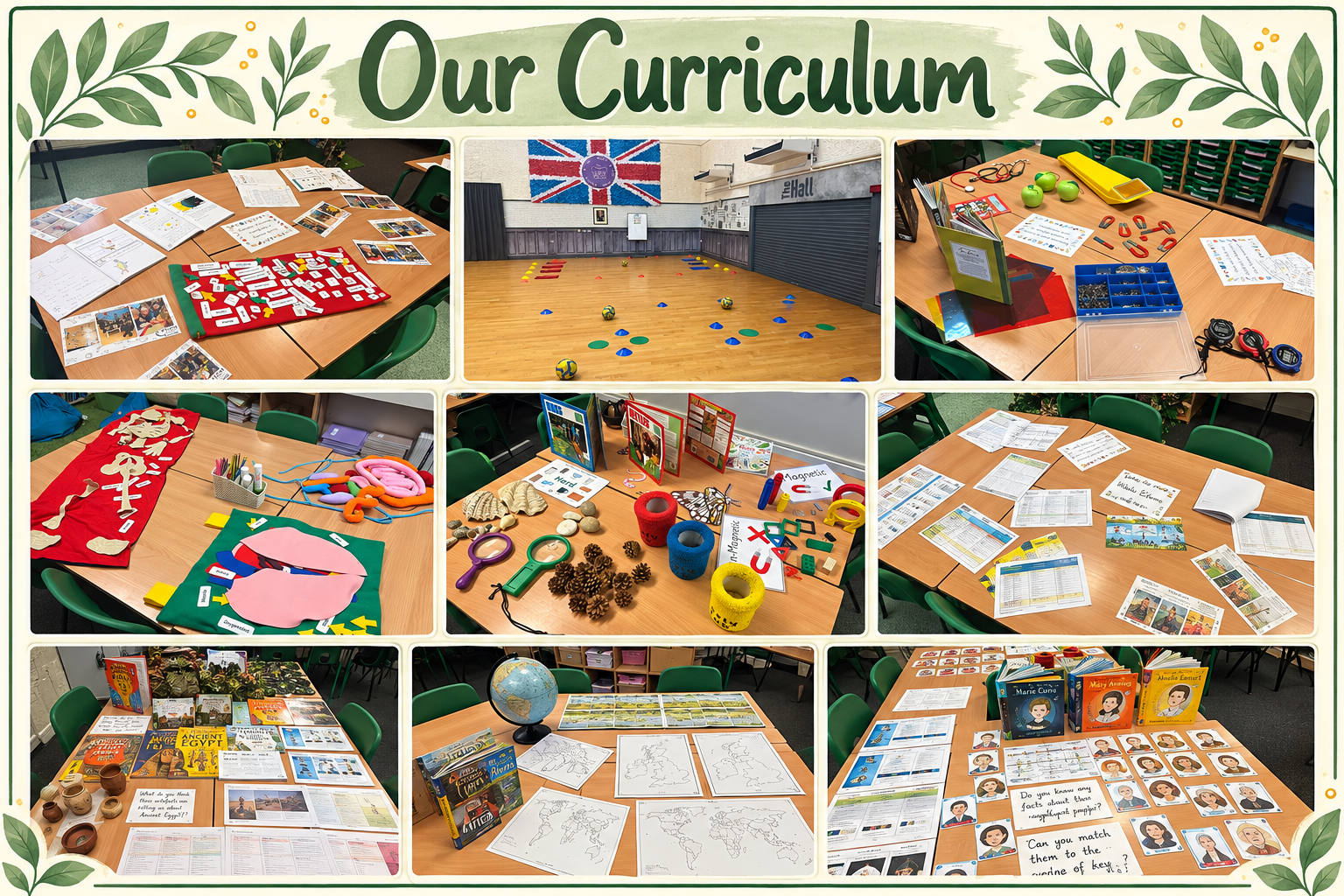
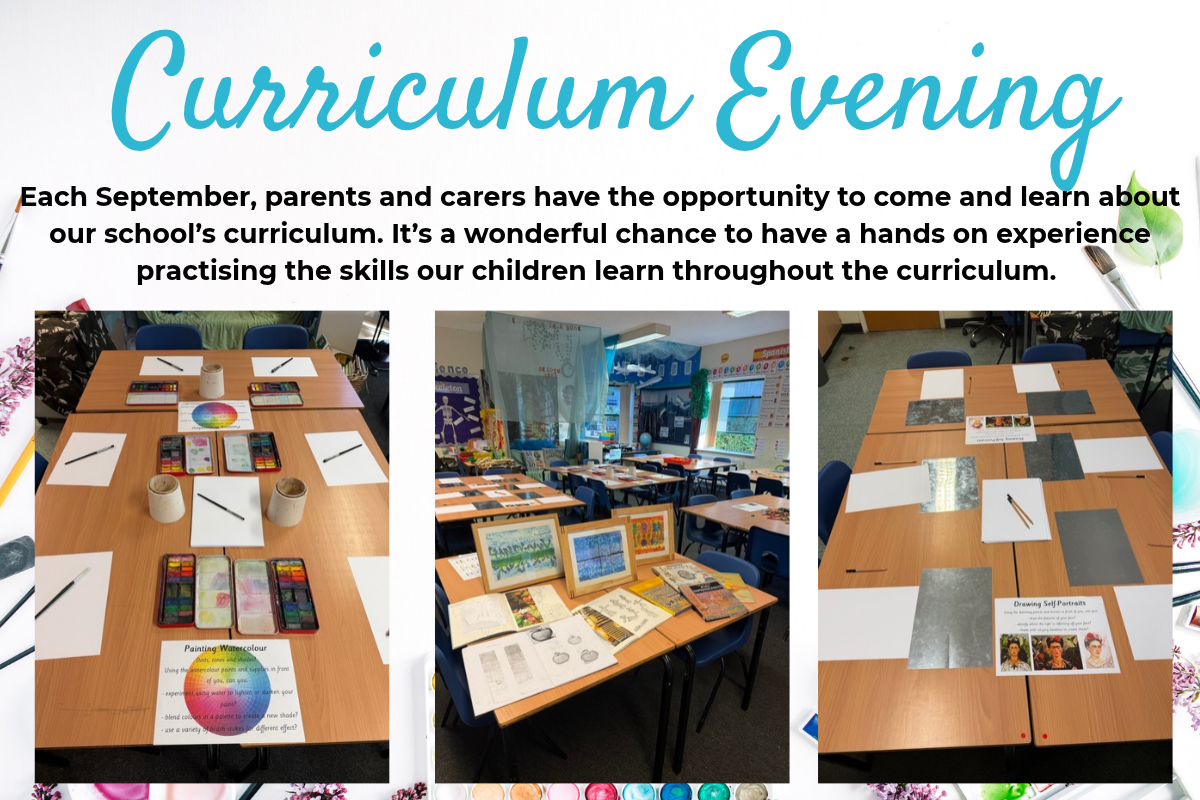
We are a creative curriculum school and place high value on the inter-relatedness of all learning. Our curriculum is delivered through exciting topics that aim to inspire and enthuse our children. Creative projects give children the opportunity to deepen their knowledge and understanding across all areas of the curriculum.
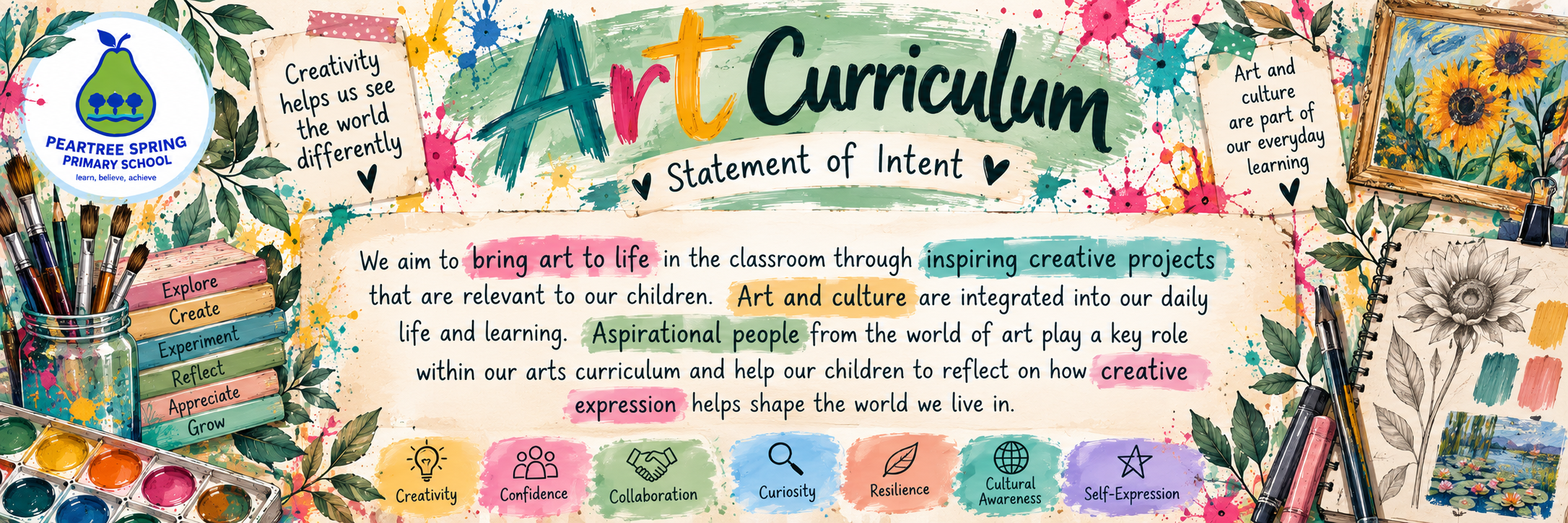
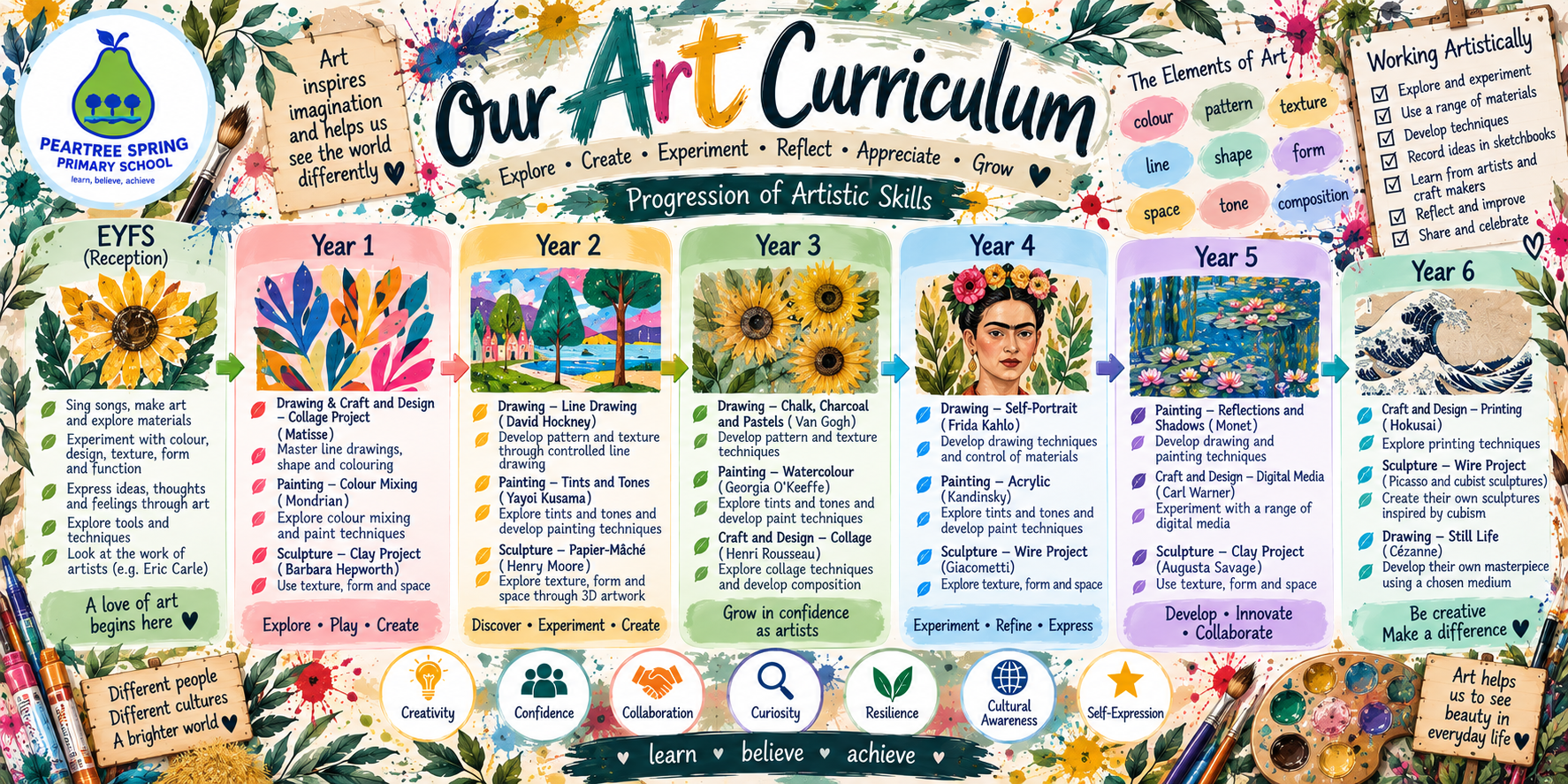
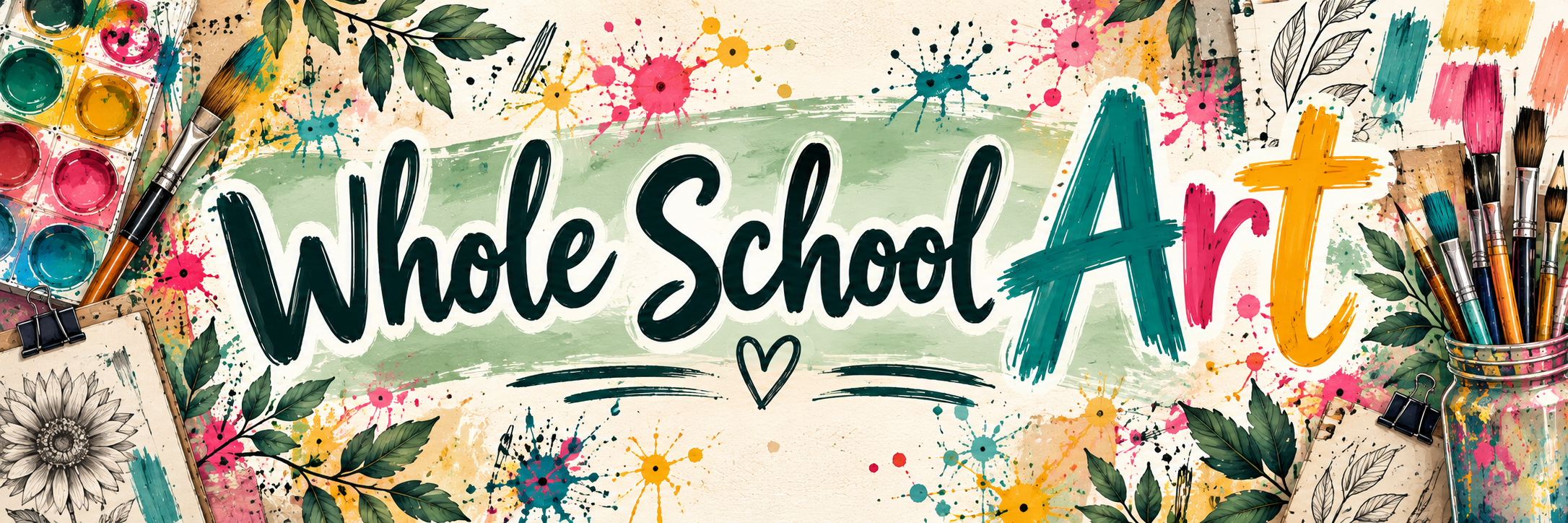
You can’t imagine a child to become creative without secure art skills. Art helps our children in expressing themselves. Creativity is a significant reason why art is emphasised in our school. Our curriculum has been designed with this in mind, bringing in a diverse range of artists, both current and historic, and a continuously developing set of skills for pupils to build upon through each key stage.
King Charles III’s Coronation
We absolutely loved creating artwork to celebrate King Charles II’s Coronation. Take a look at KS2’s beautiful sketches!

Remembrance Day
Every year, we come together as a school to design and create beautiful artwork, to pay tribute to those who lost their lives in World War One.

We are always incredibly proud of our children for the skills they use to produce their wonderful artwork and it is always so lovely to see the enjoyment of having the freedom to express themselves through a high level of creativity.

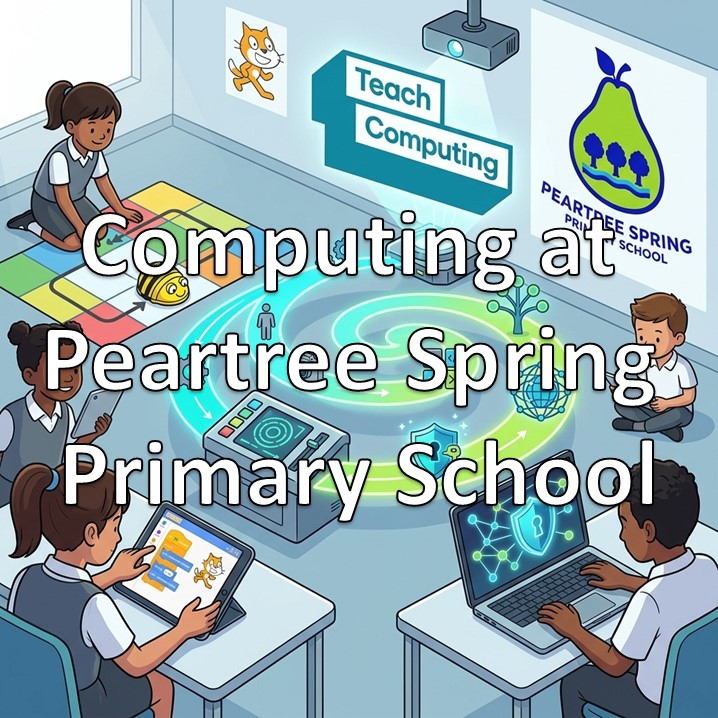
At Peartree Spring Primary School, we use the ‘Teach Computing’ curriculum, an expertly crafted program designed by the National Centre for Computing Education. We chose this comprehensive framework because it is built on the latest educational research and provides a highly structured, spiral approach to learning. This means that fundamental concepts in computer science, digital literacy, and information technology are introduced early and revisited regularly, allowing children to deepen their understanding each year. By adopting this curriculum, we ensure our students are equipped with the foundational digital skills, computational thinking, and online safety awareness necessary to thrive in an increasingly technology-driven world.
In Key Stage 1, children transition from their early experiences with technology into structured, hands-on computing. A particularly exciting element in this phase is the introduction to programming using programmable floor robots; pupils learn that algorithms are simply sets of precise instructions needed to achieve a specific outcome. They also begin creating digital media by using devices to paint, write, and capture photographs, while exploring how data can be organized using basic pictograms. This phase builds directly on the exploratory play of the Early Years, establishing a vital foundation for understanding how digital devices follow commands and how we can use technology to safely express our ideas.
As students move into Lower Key Stage 2, their programming skills make an exciting leap from physical floor robots to on-screen coding using block-based platforms like Scratch. Building heavily on their prior understanding of simple instructions, they learn to create sequences, use repetition (loops), and independently debug their own digital animations and games. Their creative digital skills also expand significantly; they explore desktop publishing, photo and audio editing, and learn how to collect and structure data using branching databases. Importantly, this is the phase where children begin to look “under the hood” of the internet, developing an understanding of what networks are and bridging the gap between simply using technology and understanding how it works globally.
In Upper Key Stage 2, the curriculum challenges pupils to apply their accumulated knowledge to complex, real-world digital projects. Programming becomes much more sophisticated as children use selection (if/then statements) and variables to design interactive games, taking their block-based coding skills to the highest primary level. The creative media elements are incredibly engaging, with students designing 3D models, editing video projects, and creating their own web pages. Building directly on the foundational networking knowledge from Years 3 and 4, they critically explore search engines, data transmission, and spreadsheets, ensuring they leave Peartree Spring as highly competent, responsible, and analytical digital citizens ready for secondary school.
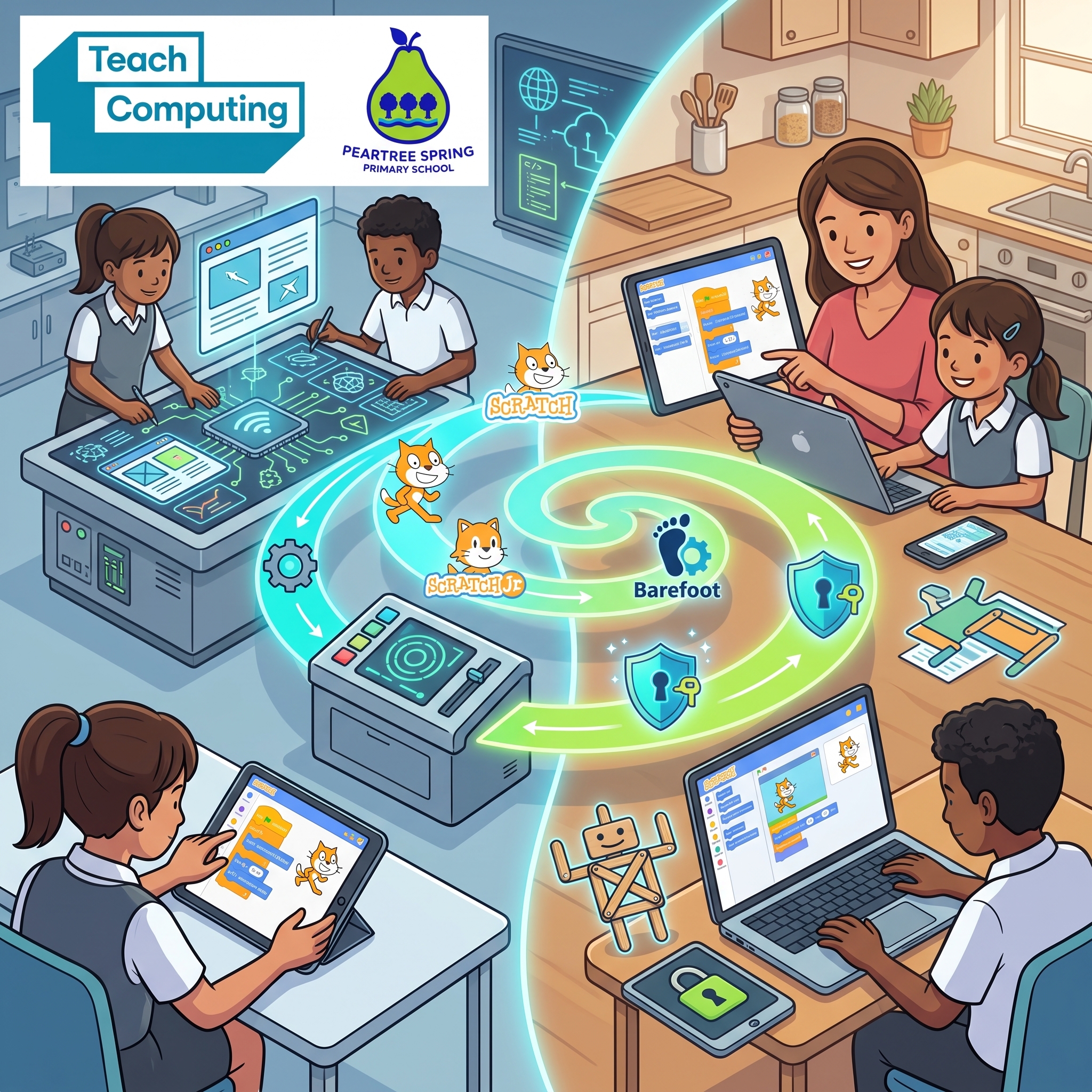
To further support your child’s computing education and safety at home, there are several fantastic, free resources available.
For coding practice, ScratchJr (a free tablet app for younger children) and the main Scratch website (for ages 8+) are excellent platforms that allow children to experiment with block-based programming in a fun, creative environment.
You can also explore the Barefoot Computing website, which offers engaging “unplugged” activities to build computational thinking without needing a screen.
Finally, for essential advice on navigating the digital world safely, the Internet Matters and CEOP Thinkuknow websites provide outstanding, age-appropriate guides to help you manage screen time, set up parental controls, and confidently keep your child secure online.
ScratchJr: https://www.scratchjr.org/
Scratch: https://scratch.mit.edu/
Barefoot Computing: https://www.barefootcomputing.org/
Internet Matters: https://www.internetmatters.org/
CEOP Thinkuknow: https://www.thinkuknow.co.uk/
At Peartree Spring Primary School, we have high ambitions for all our children to flourish in today’s technological and design rich society. Our Design and Technology curriculum aims to inspire innovative and inventive thinkers who can identify problems, develop creative solutions and design products that meet a real need or purpose.
Through engaging, practical projects, children learn to investigate existing products, generate ideas, develop designs, select appropriate materials and tools, and create purposeful products. They are encouraged to test their ideas, solve problems, adapt their designs and evaluate the quality and effectiveness of their finished products against clear design criteria.
As pupils progress through the school, they develop increasingly confident practical skills in structures, mechanisms, textiles, electrical systems and food preparation. They learn to make informed choices about materials, components and techniques, considering function, appearance, durability, safety and sustainability.
Our curriculum connects learning to real life through iconic structures, influential designers, engineers, chefs and other inspiring professionals. Children develop an understanding of how Design and Technology shapes the world around them and how creativity, innovation and enterprise can be used to solve problems and improve people’s lives.
We want our children to become resourceful, resilient and reflective designers who are willing to experiment, learn from mistakes and improve their work. Through opportunities to plan, make, present and evaluate products, pupils develop problem solving, communication, collaboration and entrepreneurial skills.
Our Design and Technology curriculum is inclusive and accessible to all learners. Through carefully modelled techniques, visual instructions, adapted equipment, manageable steps and appropriate scaffolding, we enable every child to participate, develop practical independence and experience success.
By the time they leave Peartree Spring Primary School, our children will be confident young designers and makers who can turn ideas into purposeful products, evaluate their effectiveness and recognise the role that design, engineering and technology play in shaping the future.
By the end of primary school, children should be able to:
Investigate: explore existing products and understand who they are designed for and why.
Design: generate ideas, communicate plans and develop designs against clear criteria.
Make: select and use suitable tools, materials and techniques safely and effectively.
Evaluate: test products, identify strengths and weaknesses, and make improvements.
Understand technology: recognise how structures, mechanisms, electrical systems, textiles and food design work.
Think entrepreneurially: consider users, purpose, sustainability, quality and how products could be improved or marketed.
At Peartree Spring Primary School, we aim to inspire children with curiosity and fascination about the world and its people. Through an engaging and ambitious Geography curriculum, we encourage pupils to explore their local environment, investigate places beyond their immediate experience and develop a deeper understanding of the world in which they live.
Our curriculum brings Geography to life through meaningful, hands-on projects, practical fieldwork and opportunities to explore real places and geographical issues. Children develop their knowledge of the United Kingdom and the wider world, including continents, oceans, countries, cities and the diverse physical and human features that shape our planet.
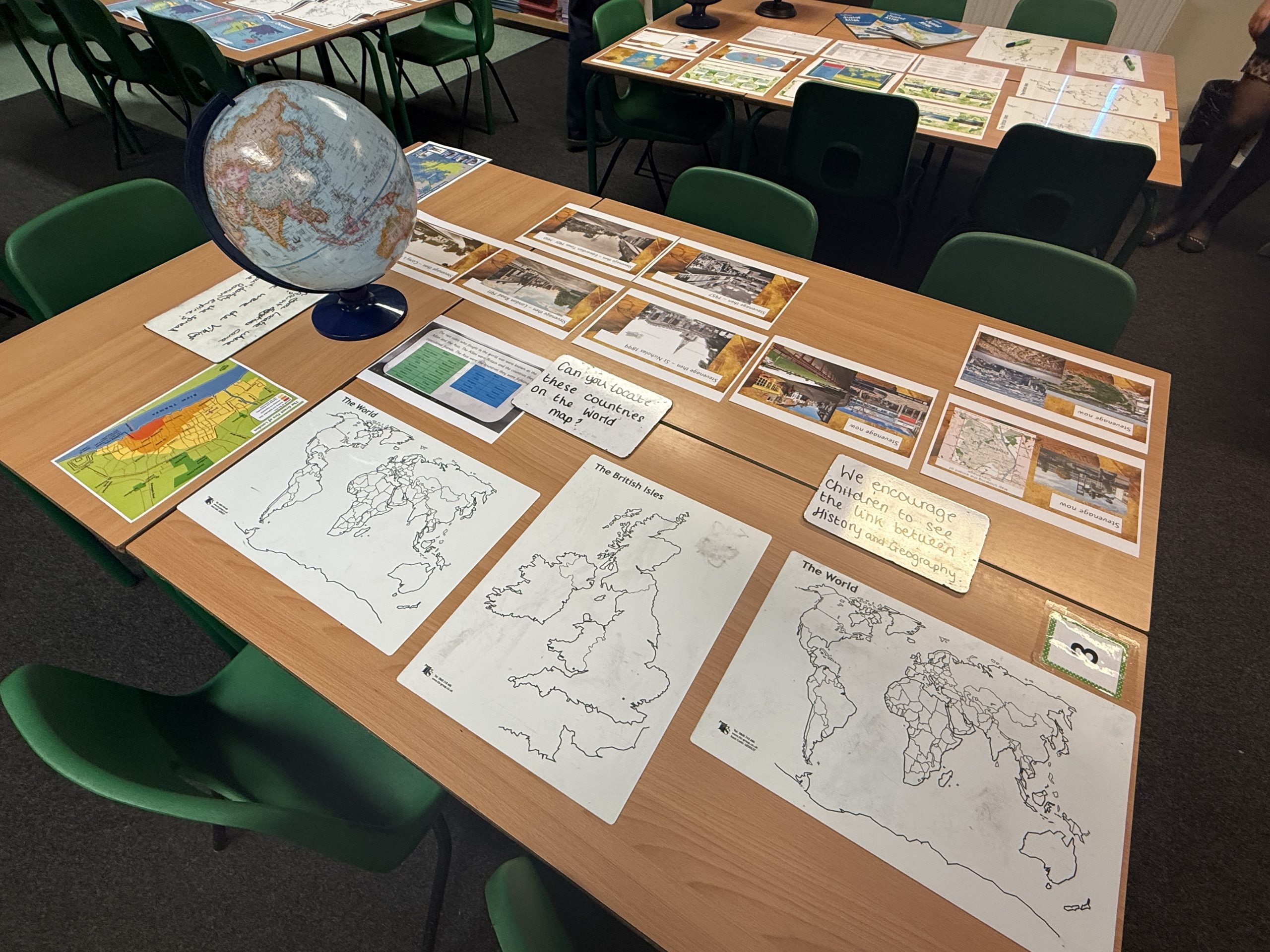
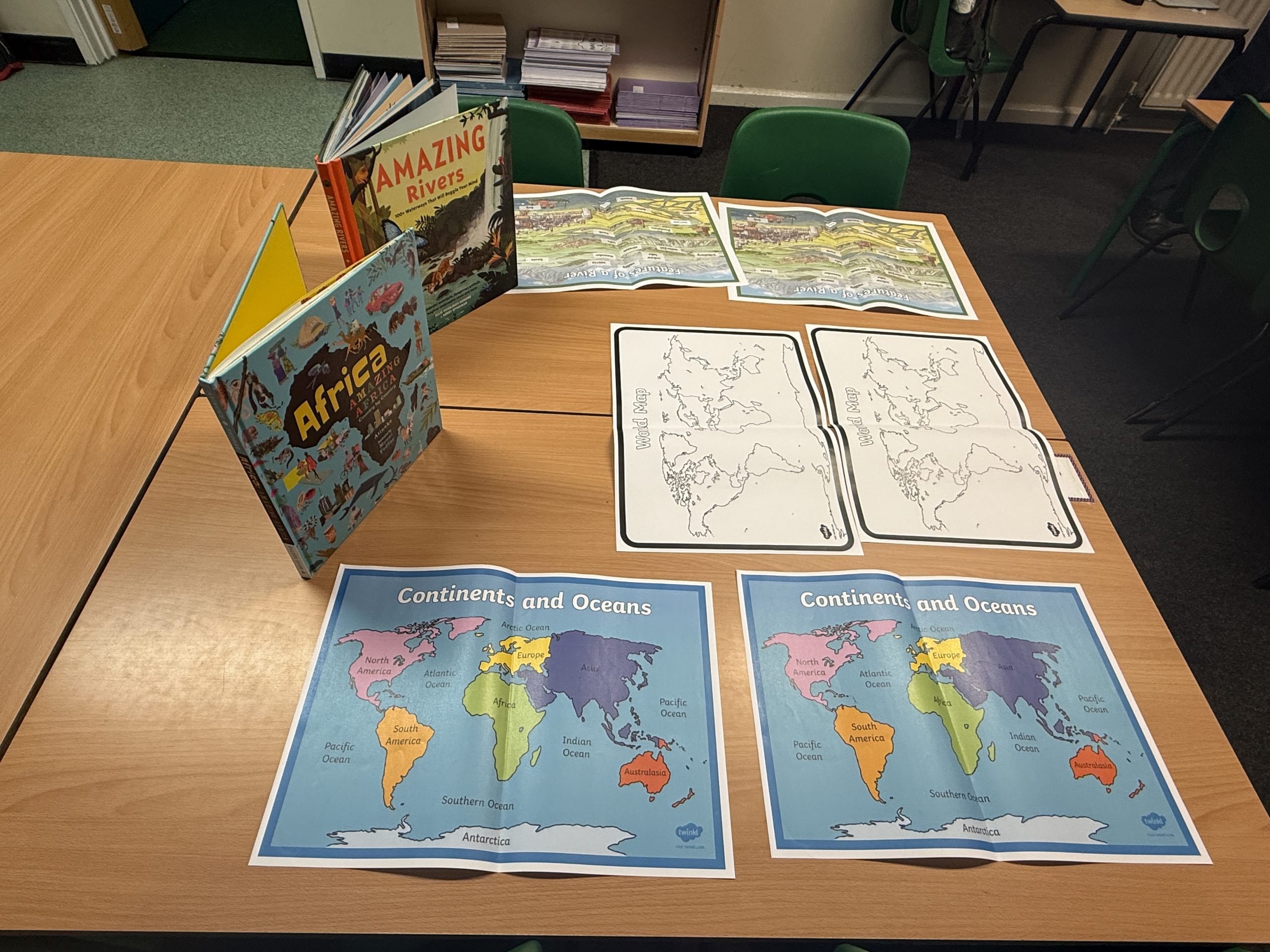
We develop confident geographers who can use maps, atlases, globes, aerial photographs and digital mapping to investigate locations, identify patterns, compare places and communicate their findings. As pupils progress through the school, they build a secure understanding of geographical vocabulary, map skills, physical processes, human environments and the relationships between people and places.
We want our children to recognise the importance of caring for the environment and understand how their actions can help shape a sustainable future. Through fieldwork, environmental projects and encounters with inspirational people and geographical careers, pupils learn to ask questions, take risks, solve problems and think critically about the world around them.
Our Geography curriculum is inclusive and accessible to all learners. Through adaptive teaching, carefully sequenced vocabulary, visual resources, practical experiences and appropriate scaffolding, we ensure that every child can participate, develop geographical understanding and experience success.
By the time they leave Peartree Spring Primary School, our children will be curious, knowledgeable and confident geographers, equipped with the skills and understanding to explore the world, appreciate its diversity and contribute positively to its future.
| Skill | KS1 | Lower KS2 | Upper KS2 |
|---|---|---|---|
| Maps | Draw simple maps and use symbols | Use keys, compass directions and four figure grid references | Use scale, six figure grid references and digital mapping |
| Location | Name continents, oceans and UK countries | Locate UK counties, cities and countries in Europe and North America | Locate countries and cities worldwide and use latitude and longitude |
| Fieldwork | Observe and record familiar places | Measure, record and present findings using sketch maps, plans and graphs | Select appropriate methods, analyse evidence and communicate conclusions |
| Place knowledge | Describe familiar places and simple similarities and differences | Compare environments and explain human and physical features | Explain patterns, relationships and changes across different environments |


Statement of Intent
History is brought to life in our classrooms through inspiring projects that are focused
around aspirational figures from our past and present; we aim for our children to
understand their place in history and recognise their own role in shaping the
future. We have high ambition for our children to become confident historians who can transfer their skills to the wider world.
At Peartree Spring, we believe that History should be brought to life. Through inspiring projects, engaging experiences and the study of significant people and events, our children develop a strong understanding of the past and their place within it.
Our History curriculum is designed to build chronological knowledge, historical vocabulary and enquiry skills as children move through the school. We want our children to become confident historians who can ask thoughtful questions, use evidence, recognise change and continuity, and understand how the past has shaped the world in which they live.
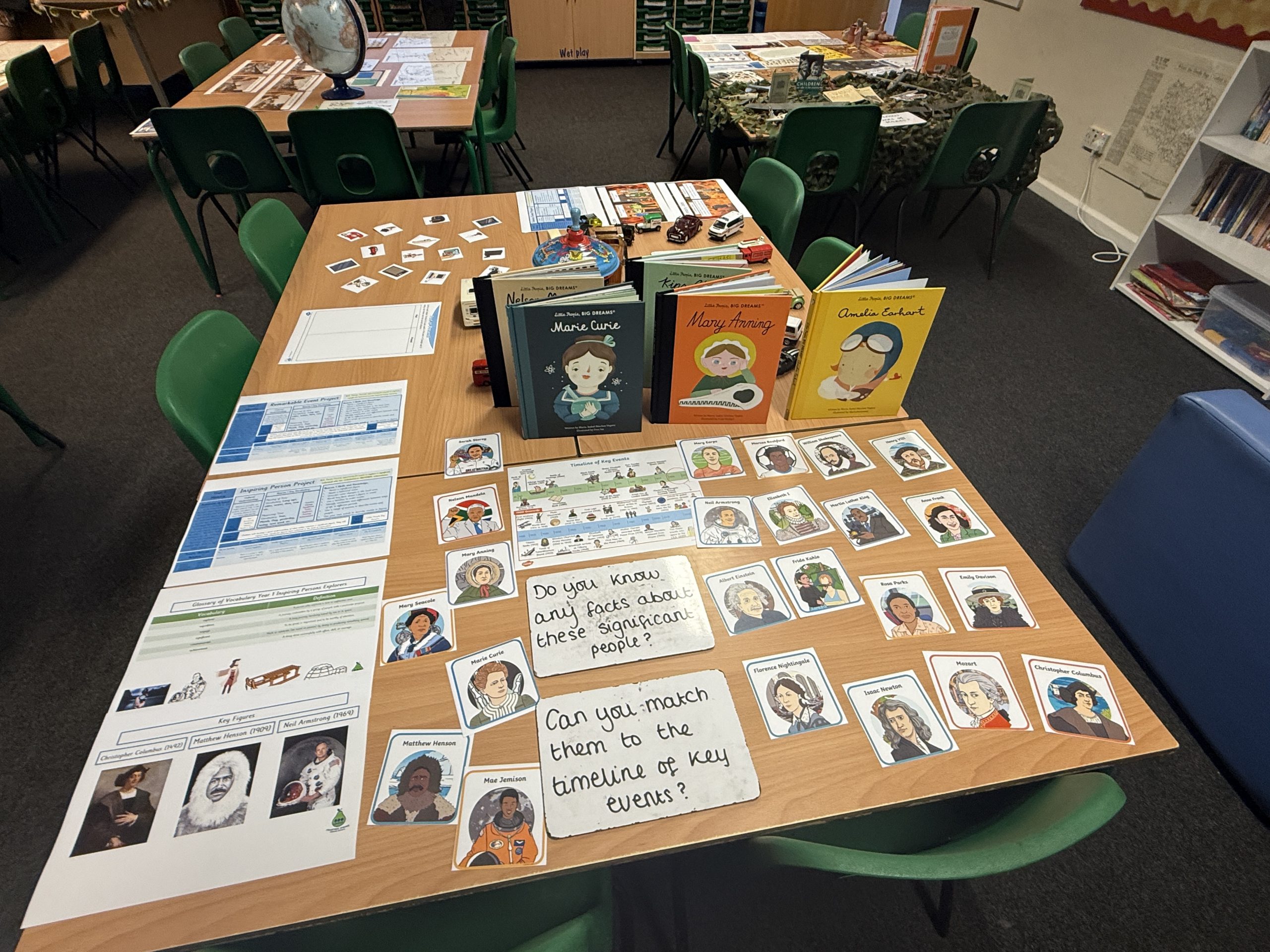
Each year group explores History through carefully chosen projects, with aspirational figures at the heart of our learning. Children encounter significant people from the past and present, considering their achievements, influence and the impact they have had on others.
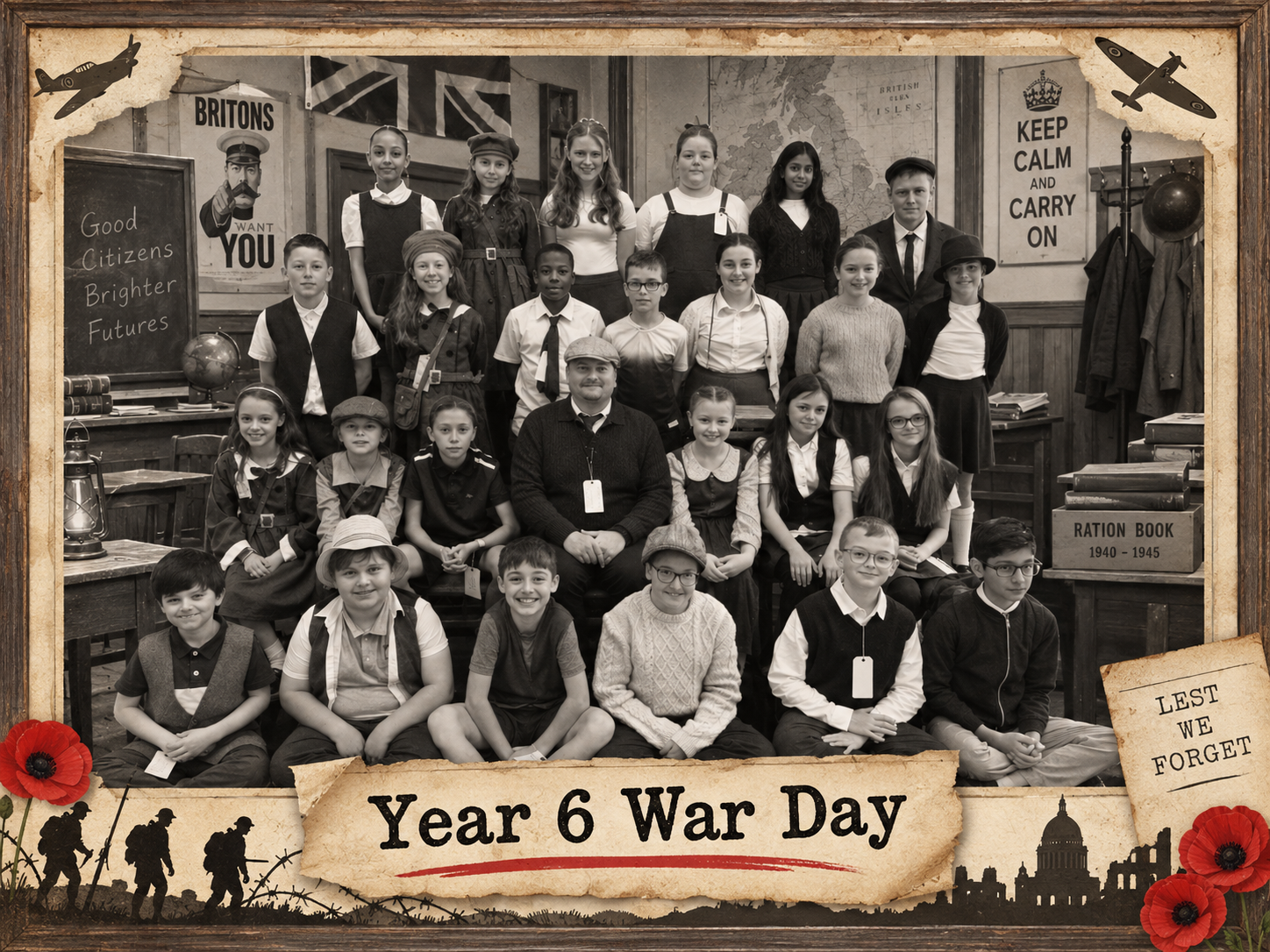
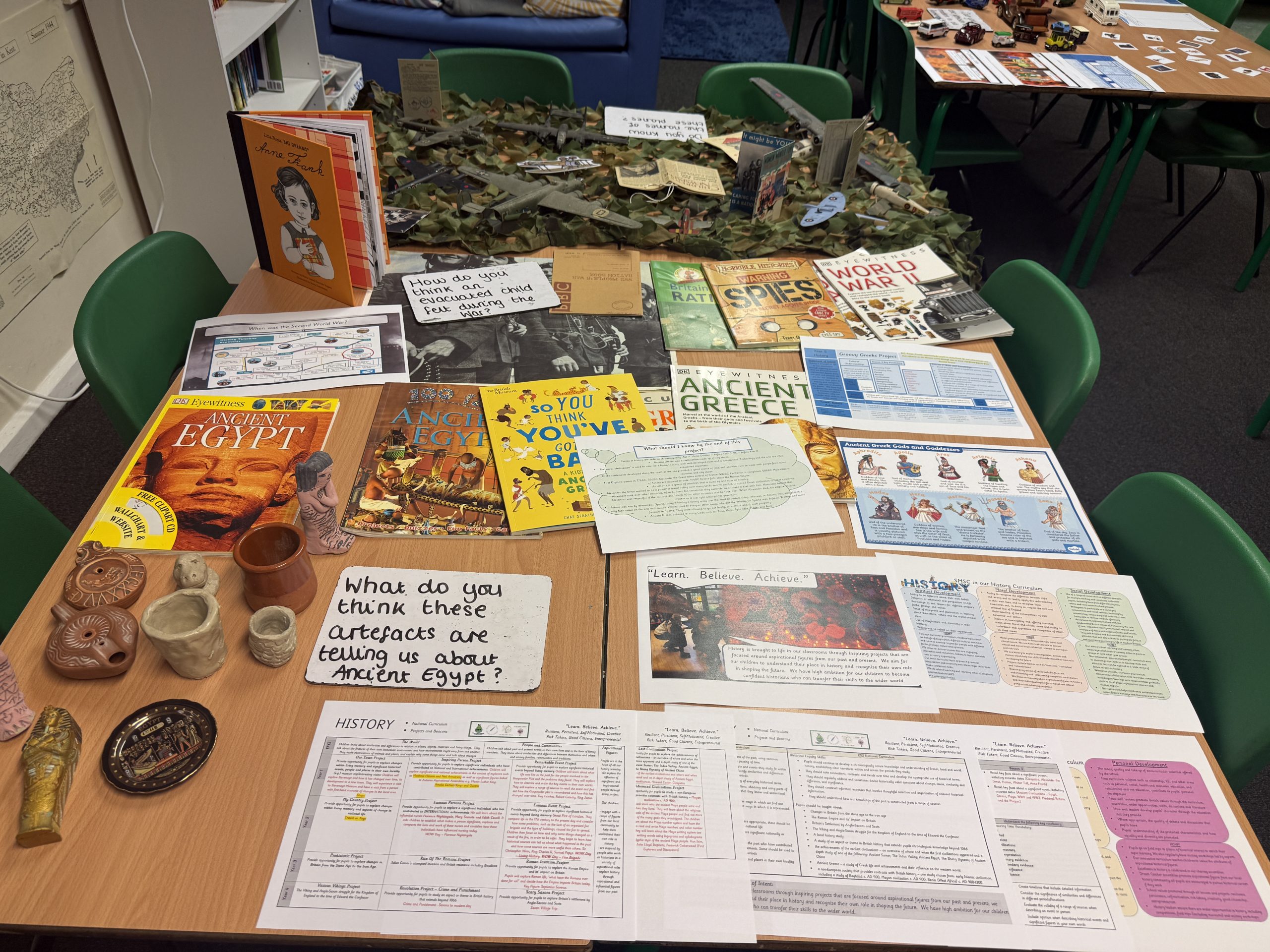
Our younger children begin by exploring changes within living memory, significant local history, people and events, including the history of Stevenage. As children progress through the school, their studies become increasingly chronological and extend from Prehistory and the Romans through to the Vikings, Anglo Saxons, Ancient Greece, early civilisations and significant events of the twentieth century.
Examples of our projects include:
Alongside learning important historical knowledge, children progressively develop the skills needed to think and work like historians.
In the early years of our History curriculum, children learn to order events using timelines, identify similarities and differences, use historical sources and describe events and significant people in their own words. As they progress, they learn to compare sources, use dates accurately, consider historical significance and evaluate evidence. By the end of Key Stage 2, children are developing their ability to make informed judgements and explain their understanding using historical evidence.
Our curriculum also deliberately develops children’s historical vocabulary, moving from everyday language such as past, present, old and new towards more sophisticated terminology including chronology, archaeology, artefact, empire, invasion, settlement, primary evidence, secondary evidence, significance and influence.
We believe that History is most powerful when children can connect what they learn in the classroom to the world around them. Our projects therefore include opportunities to explore local history, historical sites, museums, artefacts, sources and real experiences. Examples include exploring the development of Stevenage, visiting Stevenage Museum, investigating local sites such as Hatfield House and Knebworth House, and experiencing a Saxon Village.
Through these experiences, children are encouraged to see that History is not simply something that happened a long time ago. History helps us understand who we are, how our communities and society have developed, and how the decisions and actions of people can shape the future.
Ultimately, we want every child at Peartree Spring to leave us as a confident historian. We want them to have a secure understanding of the past, the curiosity to ask questions, the skills to investigate evidence and the confidence to transfer their historical thinking to the wider world.
Most importantly, our children should understand that they have their own place in history and their own role in shaping the future. This reflects our wider ambition for children to Learn, Believe and Achieve.


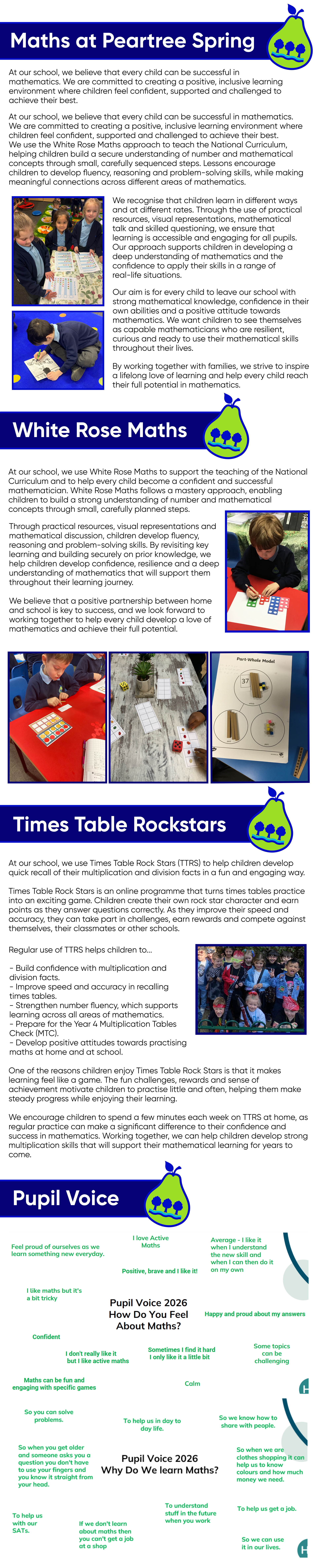
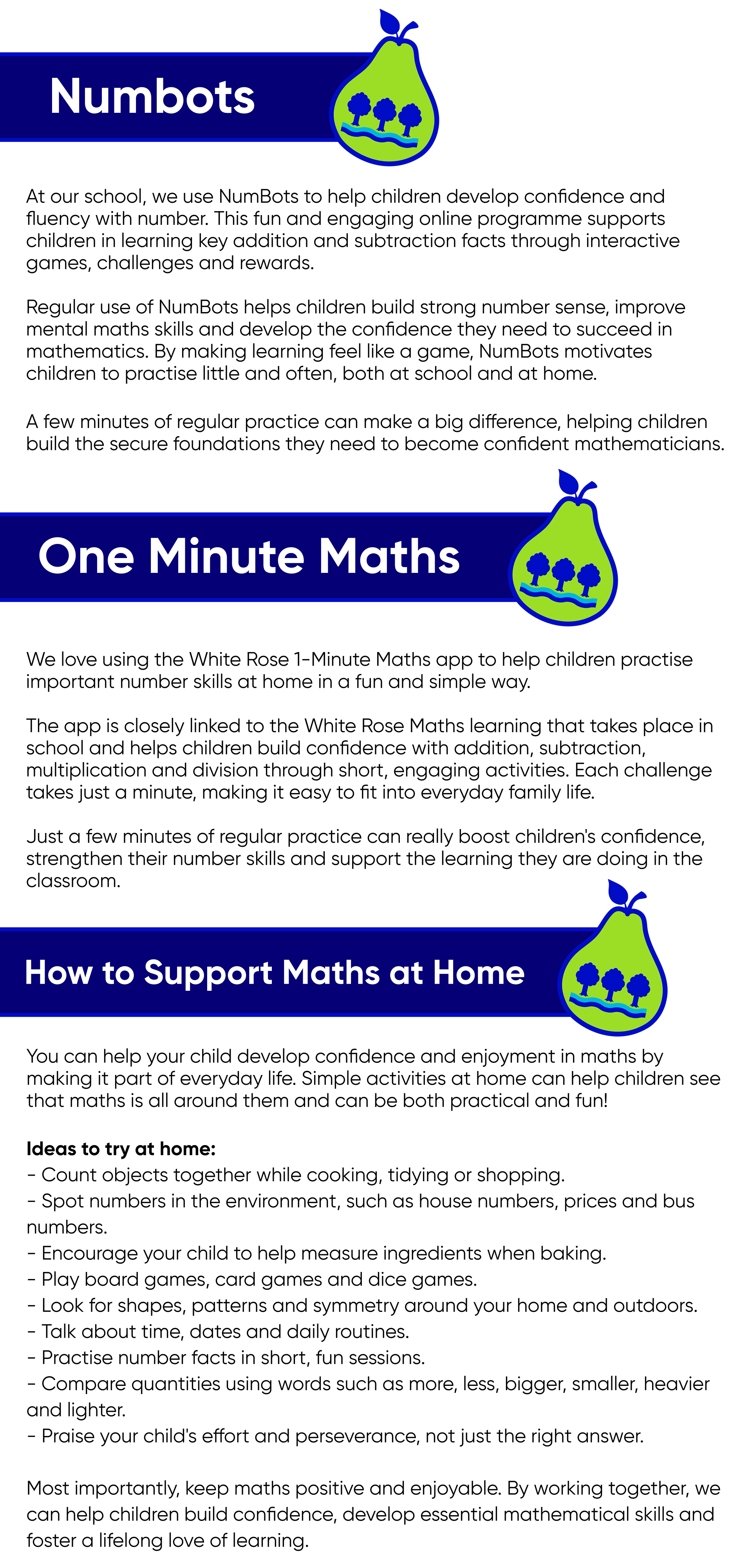

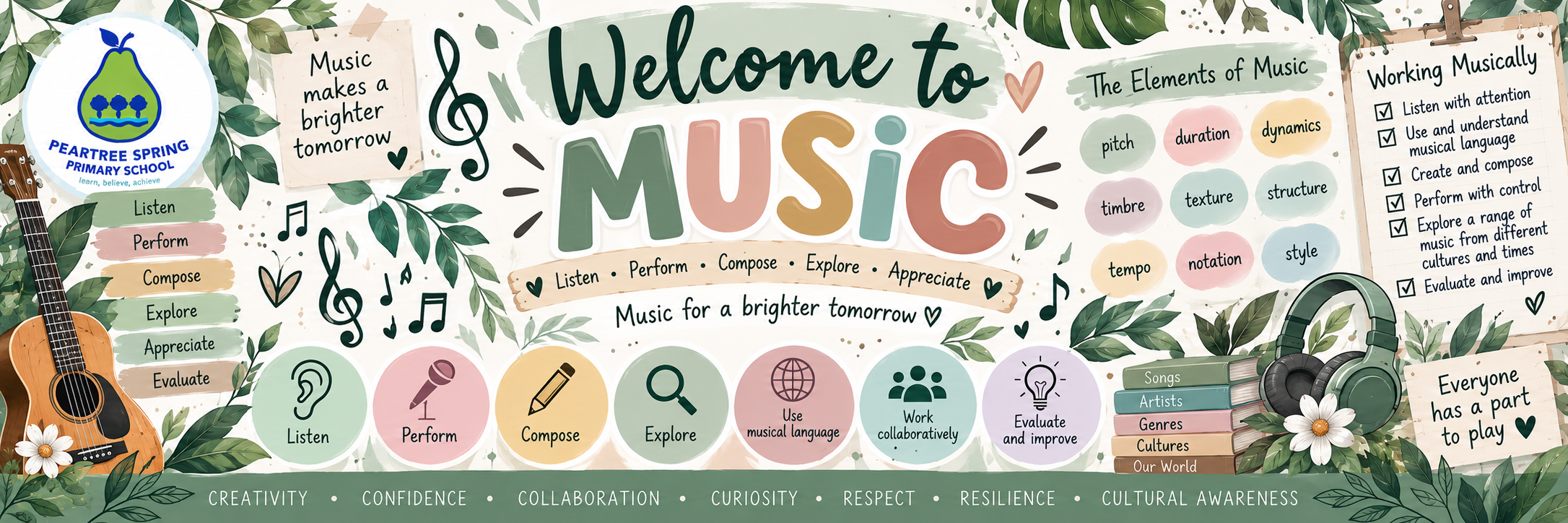
At Peartree Spring, we aim to bring music to life through an exciting, inclusive and ambitious curriculum that gives every child the opportunity to experience the joy of making, performing, creating and responding to music. We believe that music is an important part of a broad and balanced education and can develop creativity, confidence, self-expression and a sense of belonging.
At Peartree Spring, our curriculum is designed around inspiring musical projects that are meaningful and relevant to our children. Through singing, playing instruments, composing, performing, listening and evaluating, pupils progressively develop their musical knowledge and skills. Children are encouraged to experiment with sound, take creative risks and develop their own musical ideas, building the confidence to see themselves as musicians.
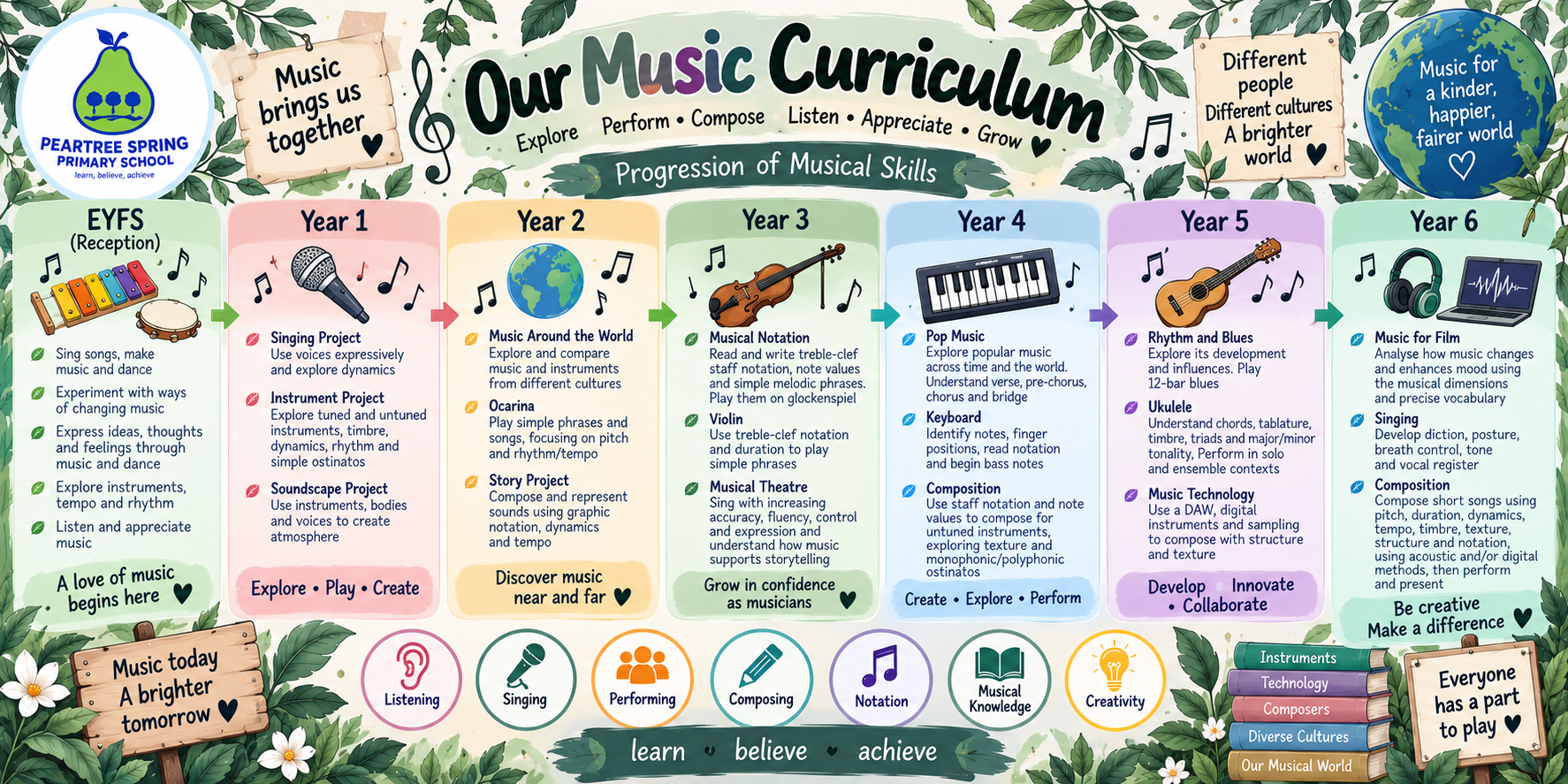
From EYFS through to Year 6, pupils experience an increasingly rich range of musical opportunities. They explore voice, tuned and untuned instruments, notation, composition, music technology and performance, with learning carefully developed so that previous knowledge and skills provide the foundations for future learning. As children progress through school, they develop greater accuracy, fluency, control, expression and independence in their music-making. This reflects the progression evident throughout our curriculum, from early exploration of sound to increasingly sophisticated performance, notation and composition.
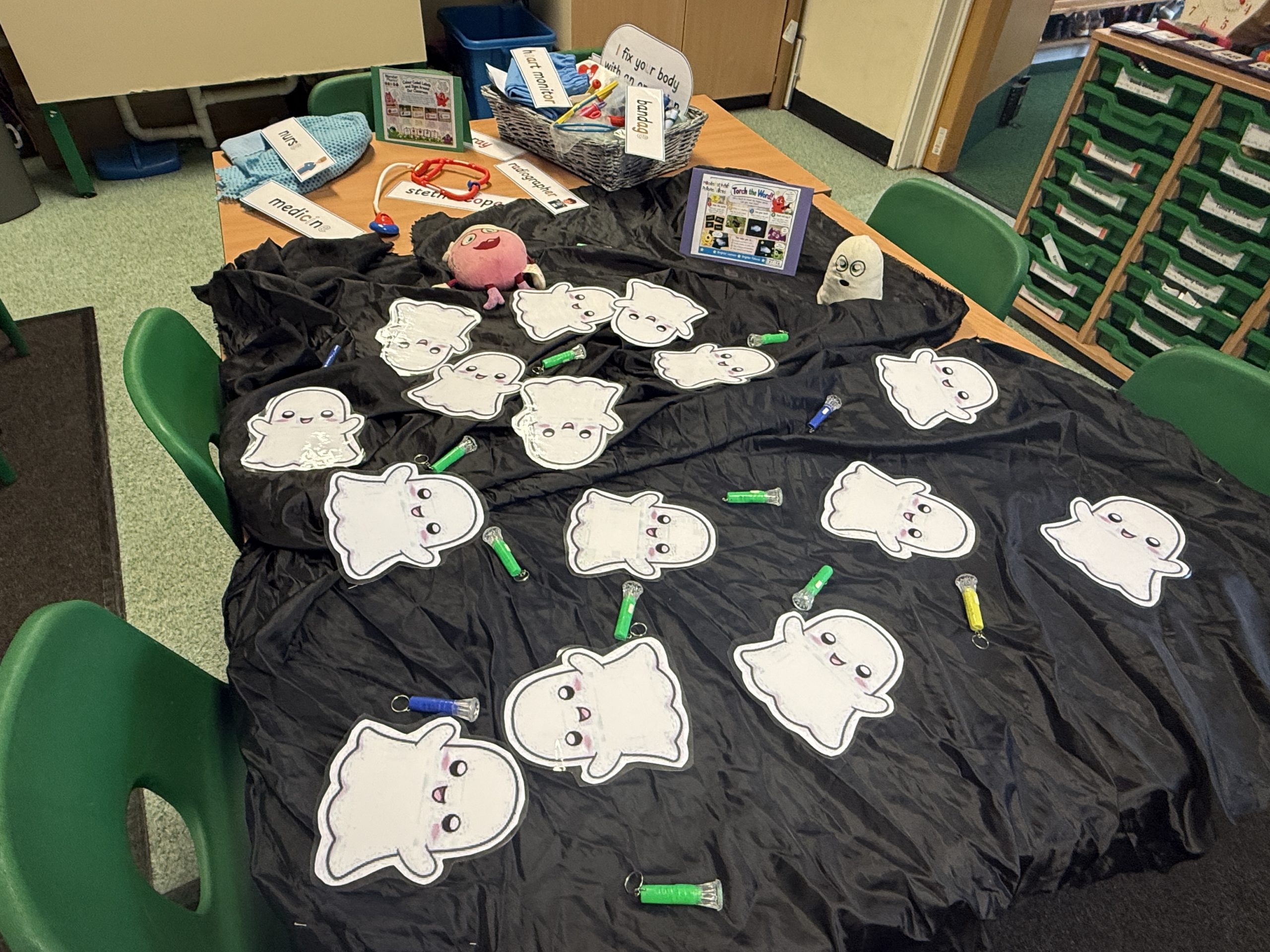
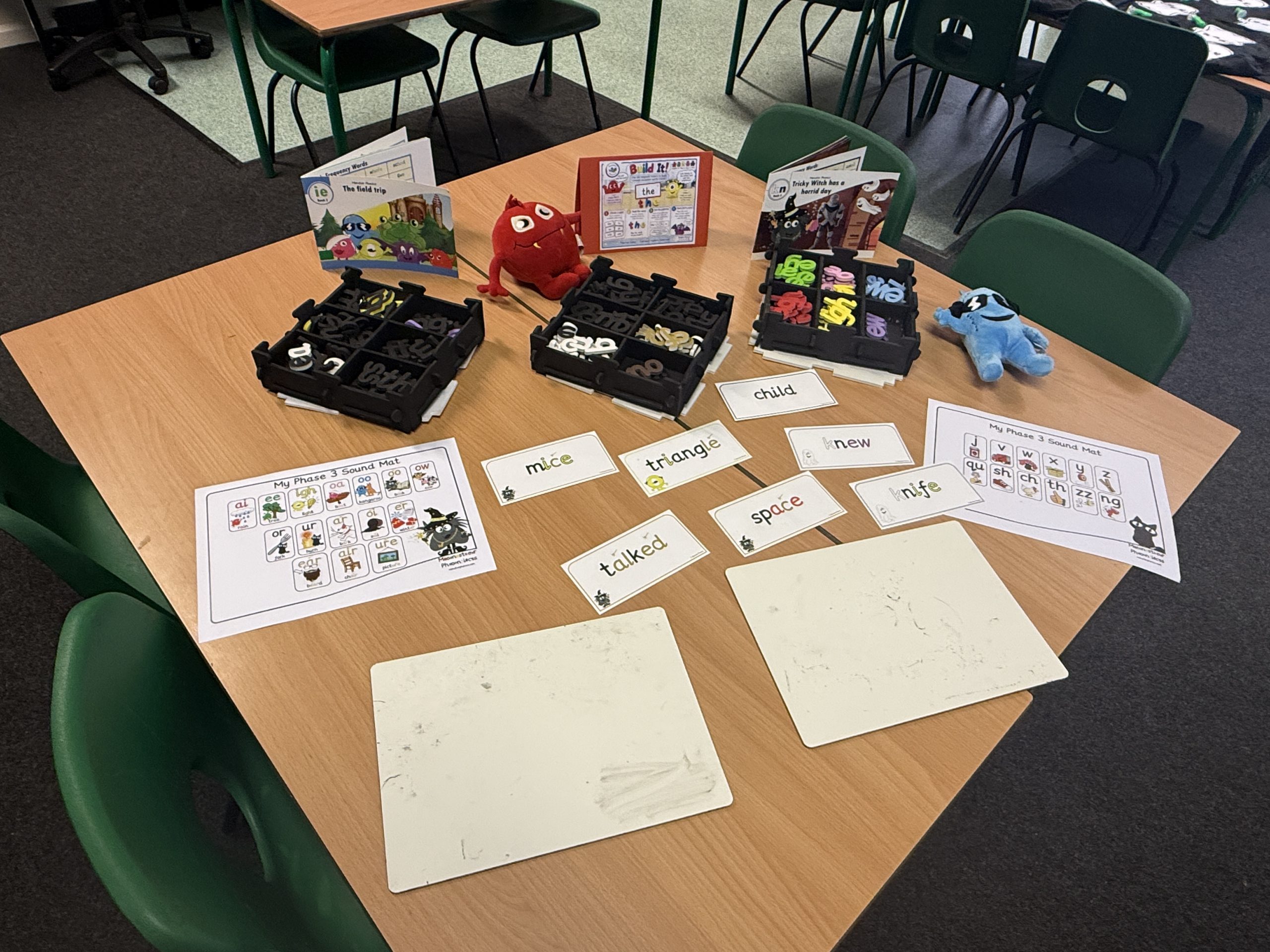
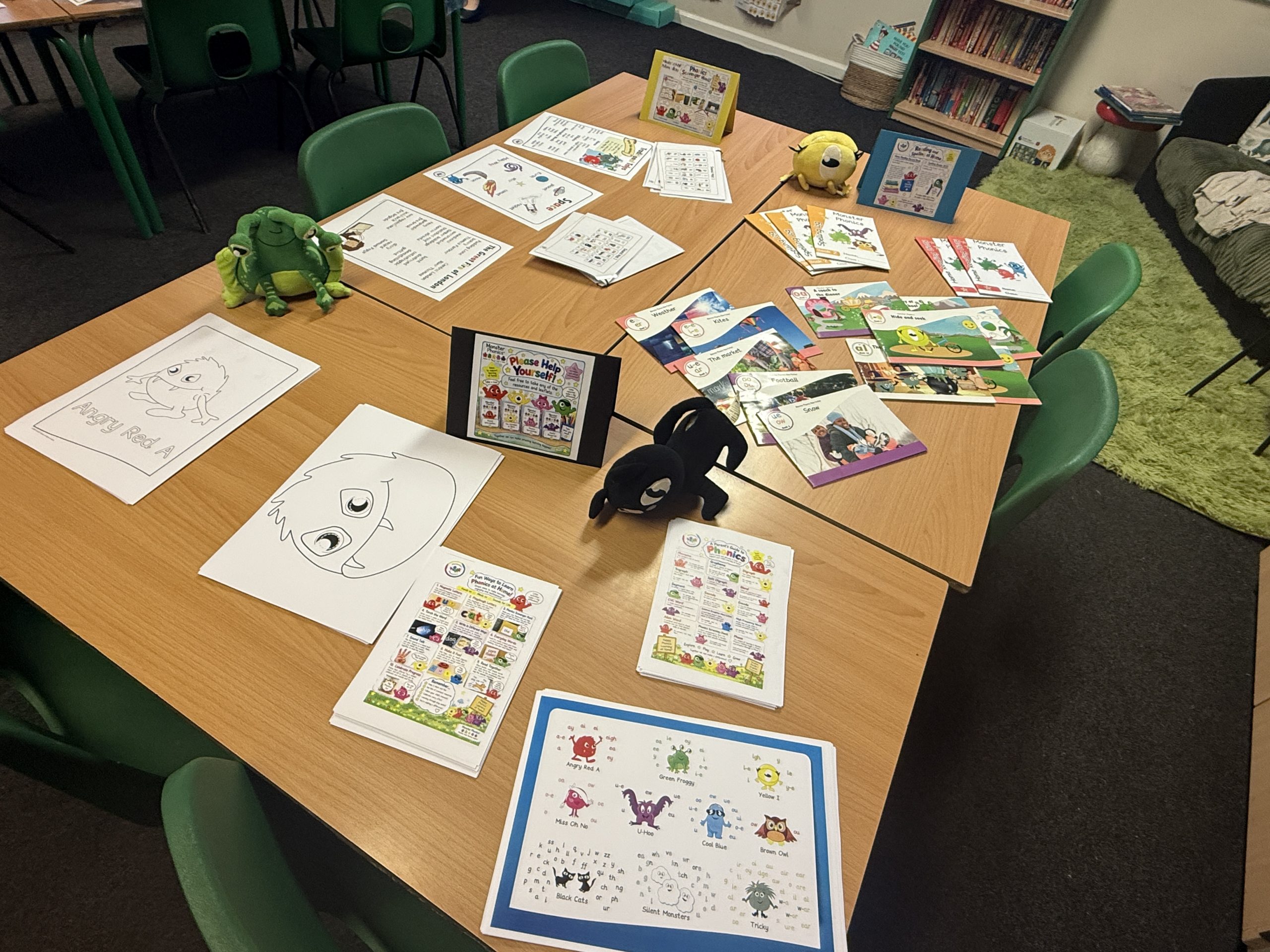
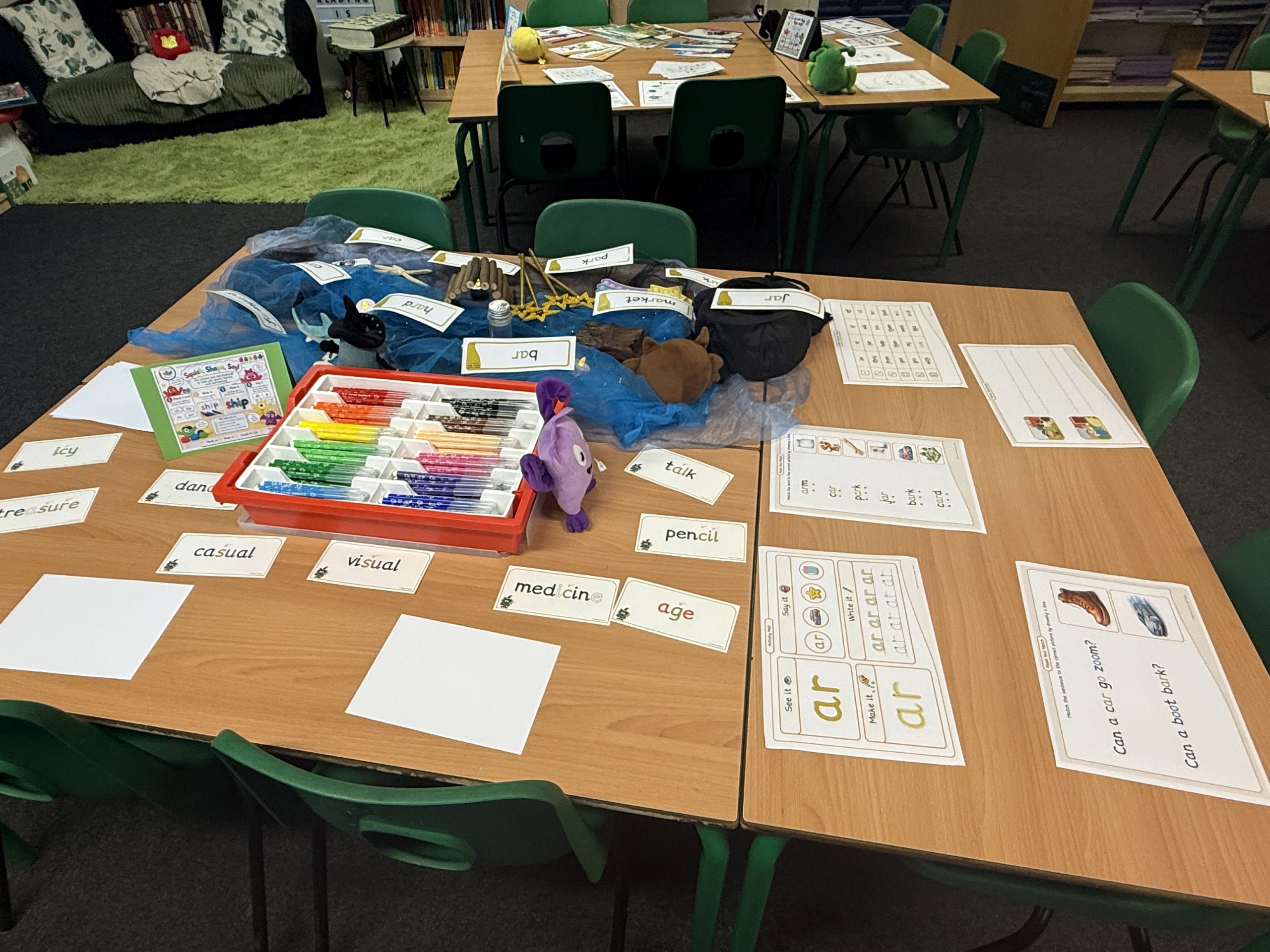
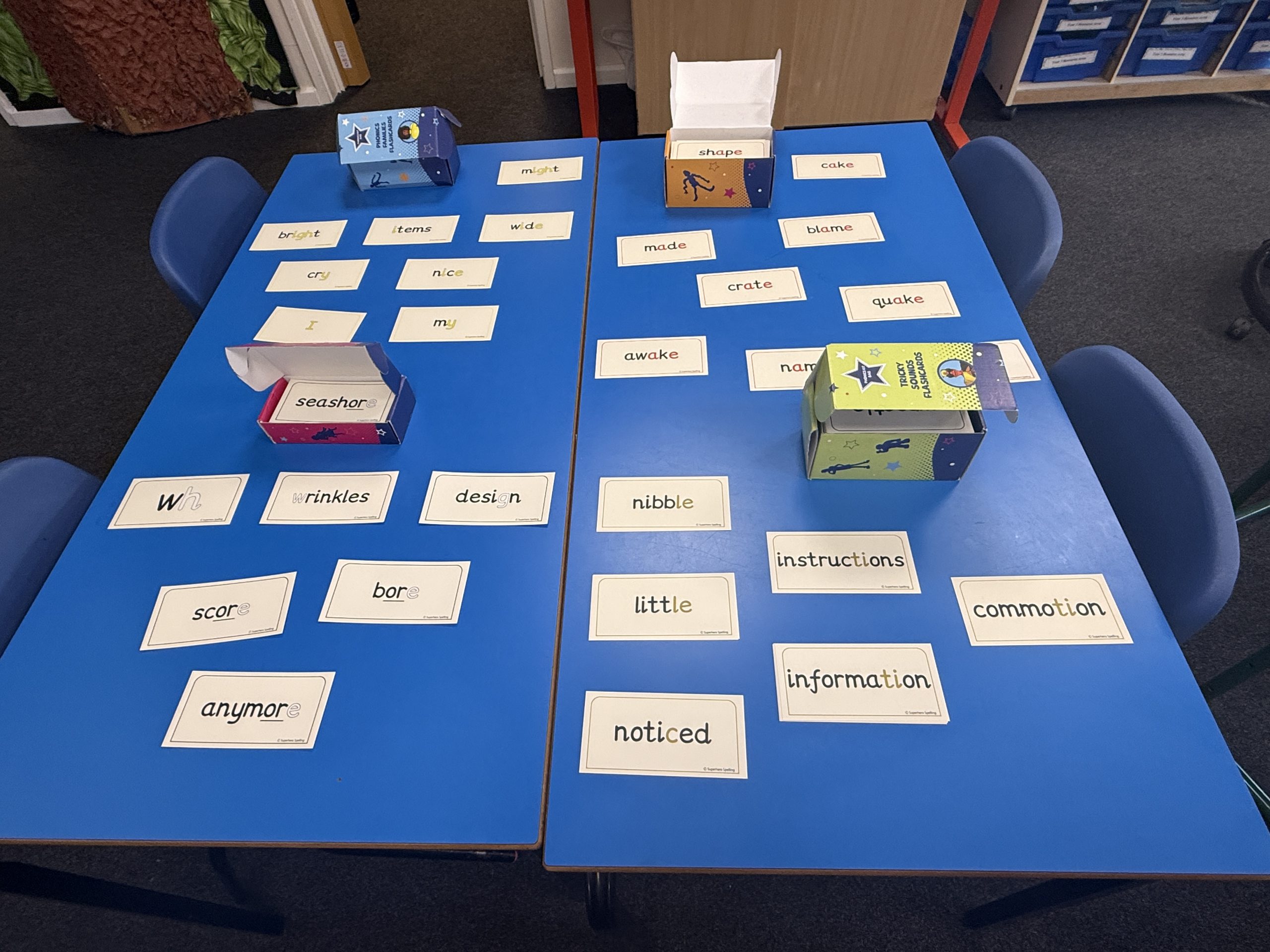
Monster Phonics is the fun way to teach Systematic Synthetic Phonics. Its advanced multisensory approach uses 10 Monster characters to create interest and engagement for children. Studies show a 38% increase in spelling accuracy in 5 weeks and a 23-month improvement in reading age over a 5-month period.
Monster Phonics uses grapheme-phoneme correspondence as the first and foremost approach. Teaching is supported by using colour and monster sound cues to make the grapheme-phoneme correspondence explicit and easier to learn. Directly linking each grapheme and sounds within words makes learning easier and fun. Once a grapheme has been taught, the colour is removed. Not only does this accelerates the learning of phonics, high-frequency words, including common exception words, are also easier to learn.
In Early Years and Key Stage 1 children will engage in:
Our English faculty work closely with Monster Phonics to deliver bespoke training for our staff to ensure we give your children the very best exposure to phonics whilst at Peartree Spring.

You can find more information about Monster Phonics by clicking the following link:

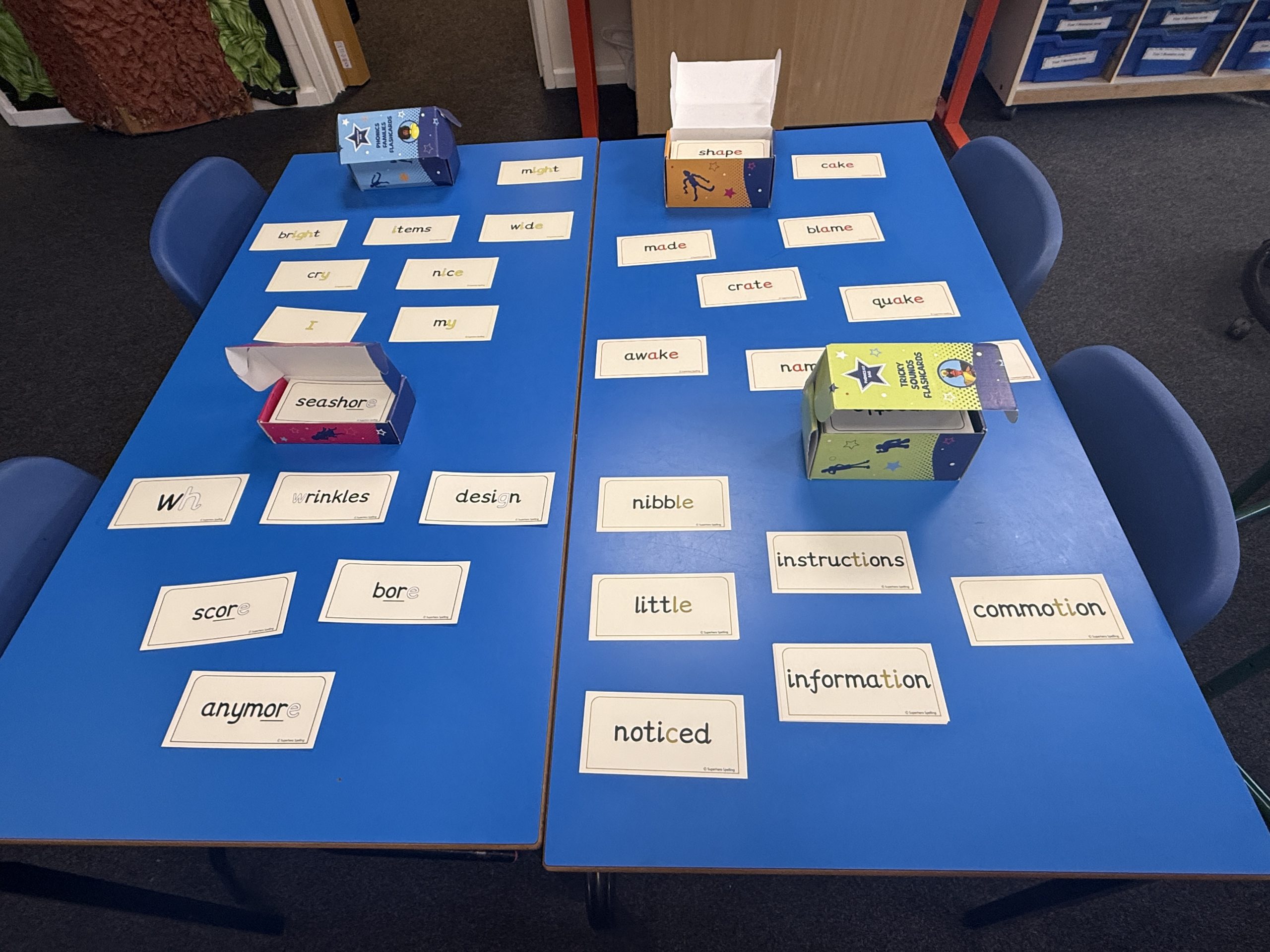
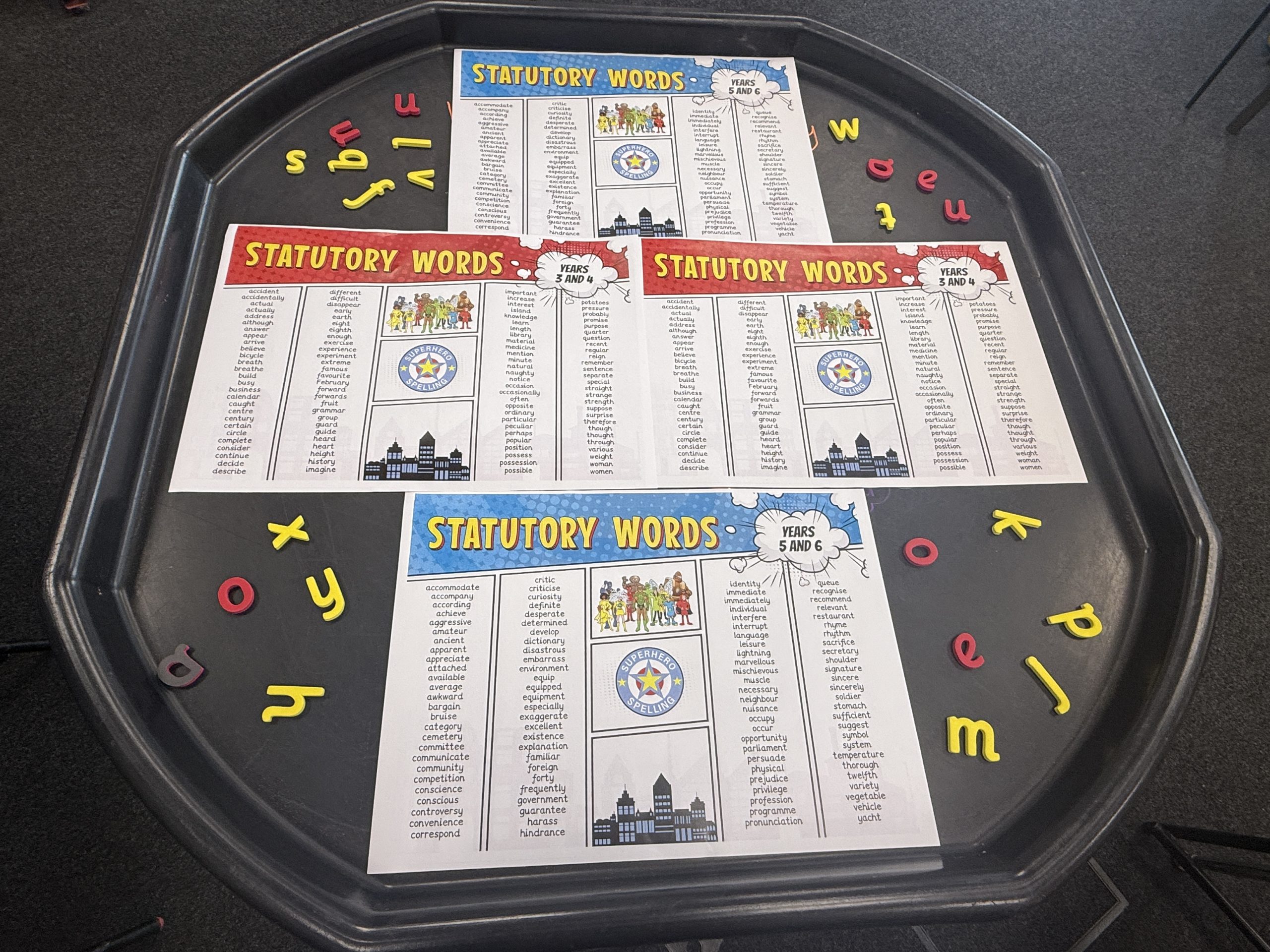
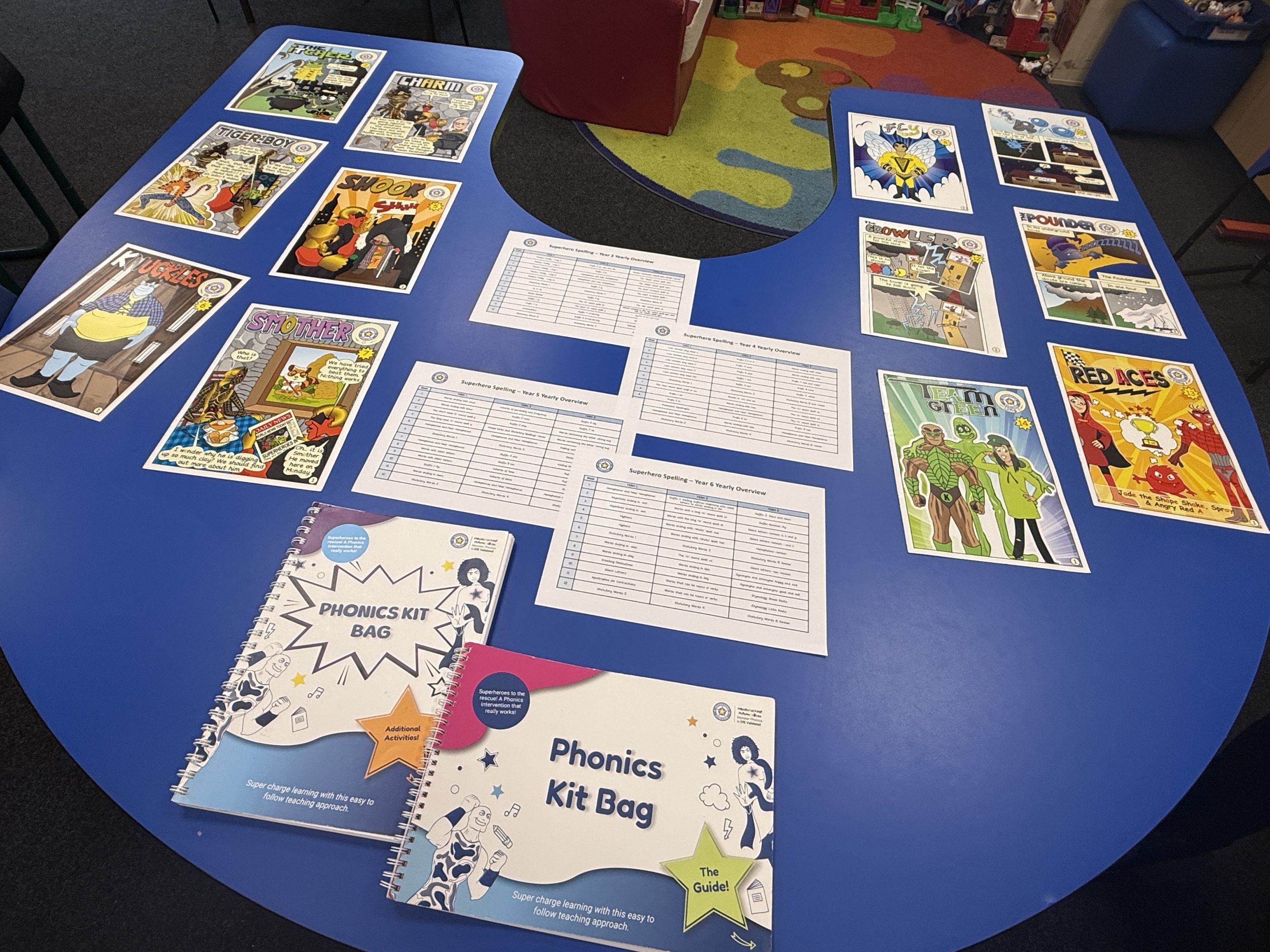
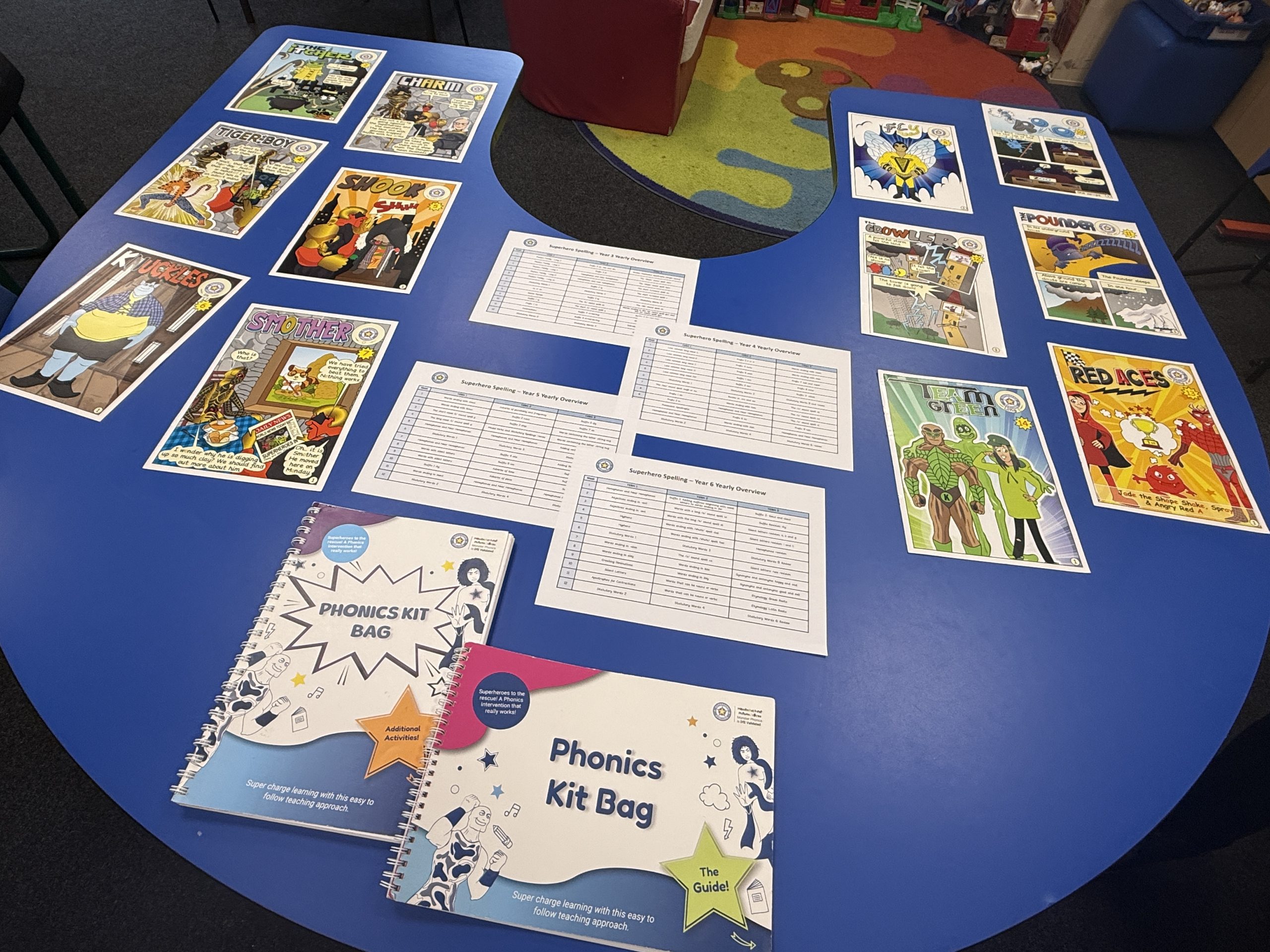
The Superhero Spelling Programme is an engaging and dynamic resource that covers the full scope of the 2014 Spelling Curriculum, ensuring your child meets all Key Stage 2 spelling requirements.
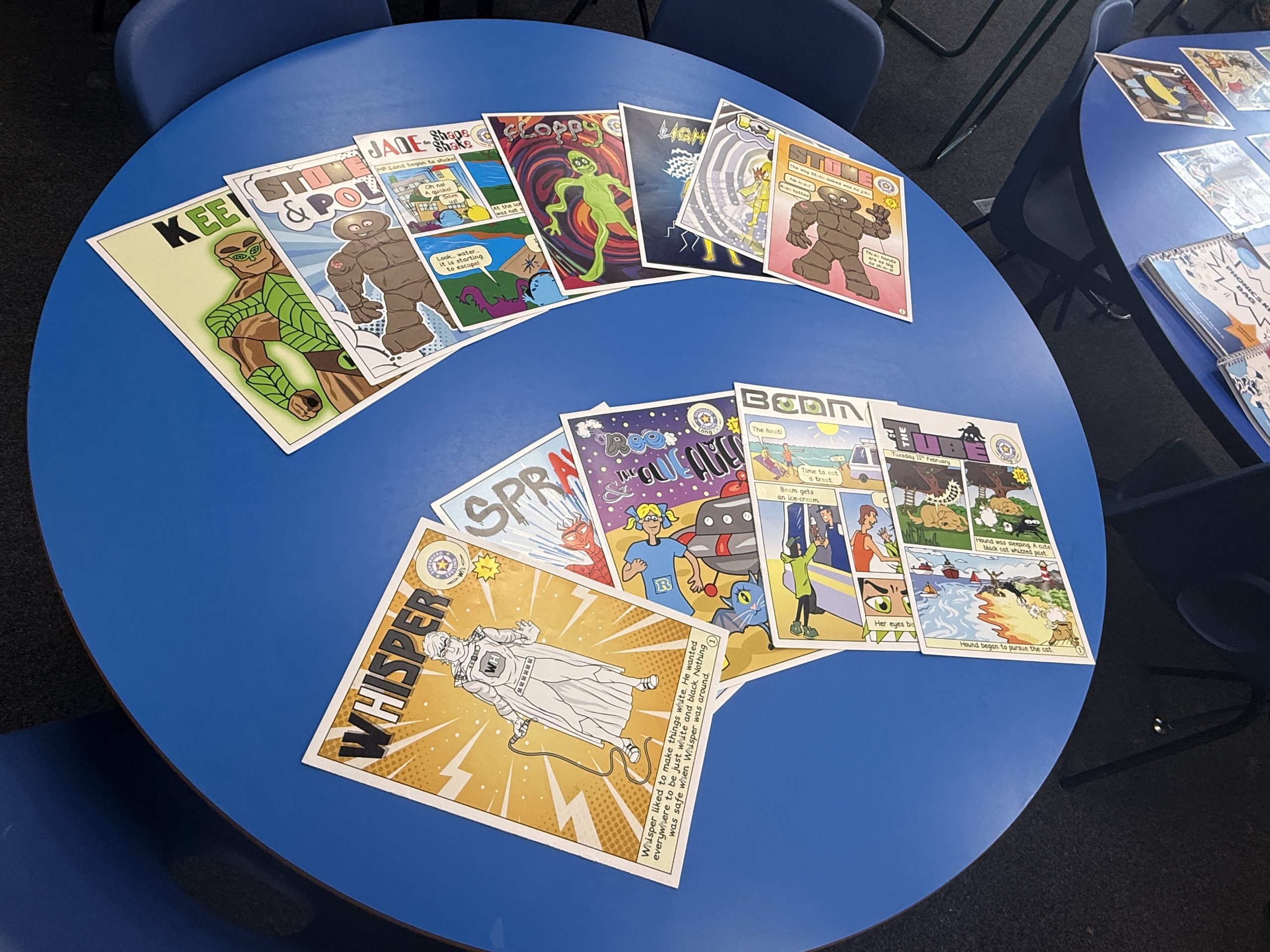
Designed to build on phonics knowledge, it embeds essential spelling rules through fun and memorable activities led by a cast of superheroes and powerful memory cues. Each lesson is interactive, with a mix of age-appropriate activities that promote active learning. Children also benefit from partner work and talk time to reinforce their learning.
Discover our cast of superheroes

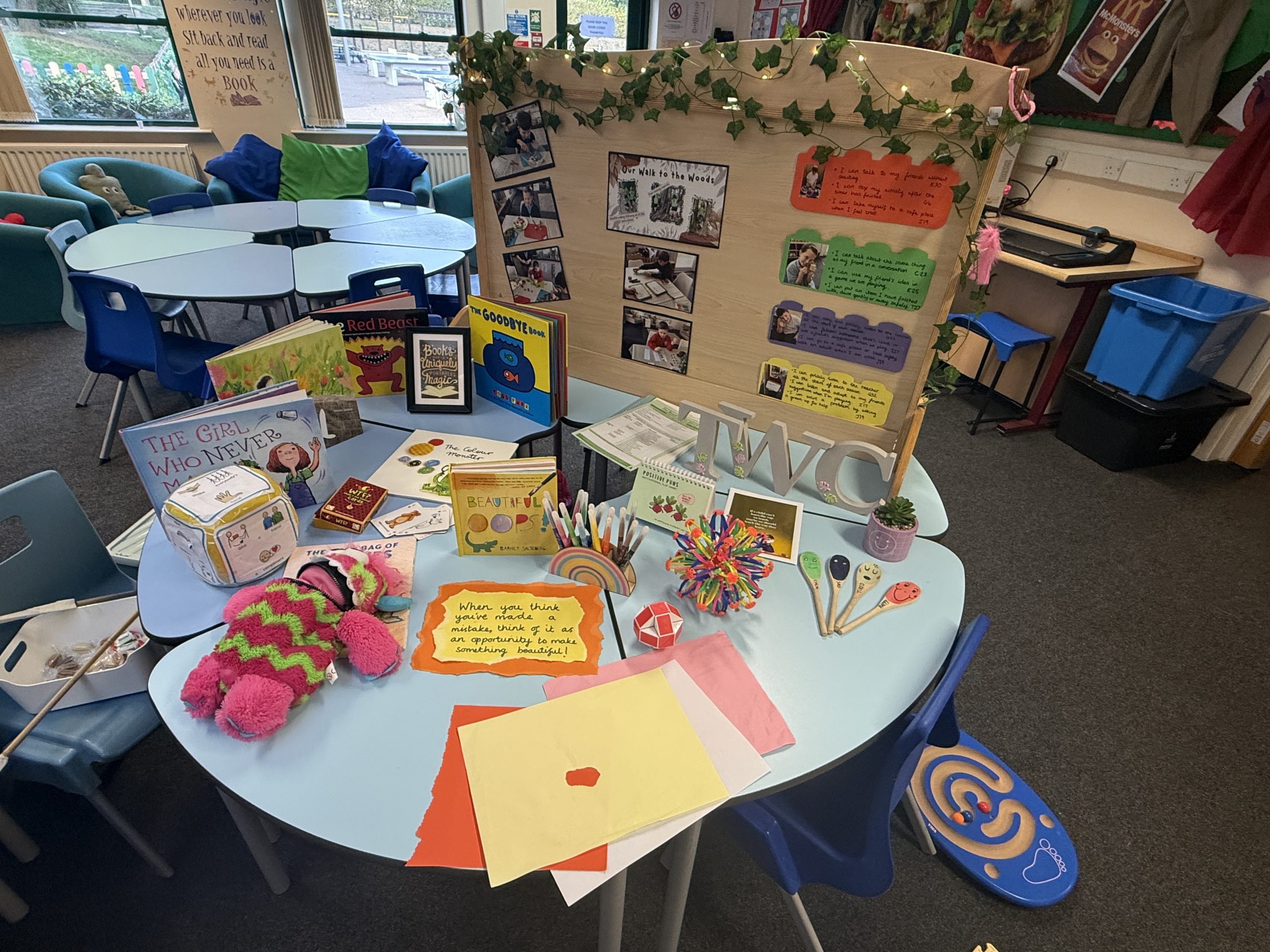
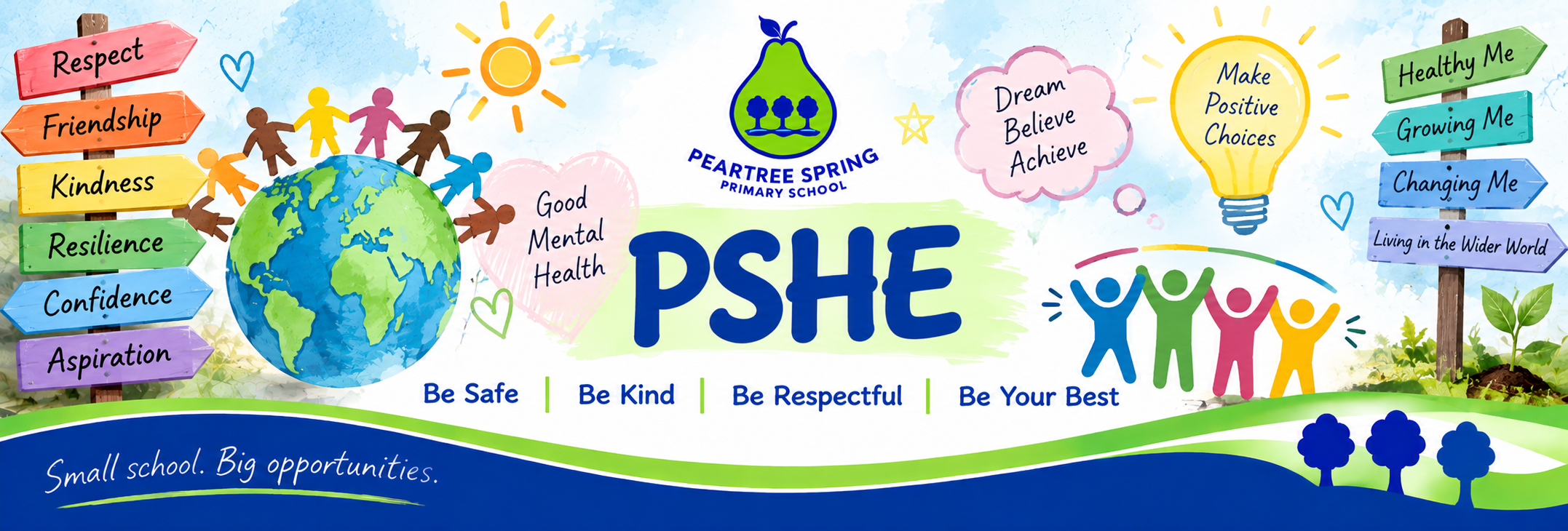

Personal, social, health and economic (PSHE) education is an important and necessary part of all pupils’ education in our school and includes statutory relationship and sex education (RSE).

In PSHE education, we aim to build, where appropriate, on the statutory content already outlined in the national curriculum: drug education, financial education, sex and relationship education (RSE) and the importance of physical activity and diet for a healthy lifestyle.
Topics include citizenship, rights and responsibilities, rewards and consequences, democracy and dealing with specific issues such as peer pressure, bullying and conflict.
Find out more on our PSHE page


We are lucky to have extensive school grounds and our teachers plan lessons that take the children outdoors at every opportunity. We believe that outdoor learning is enriching and ensures positive, innovative and creative learning experiences for all our pupils.
We aim to nurture a lifelong love of reading and inspire our children to become confident, fluent and enthusiastic readers. Our children are equipped with the knowledge, skills and strategies they need to read accurately, fluently and with understanding. Through a rich and diverse range of books, authors and texts, we aim to broaden children’s vocabulary, develop their imagination and deepen their understanding of themselves, others and the world around them.
We actively promote reading for pleasure alongside purposeful reading, encouraging children to explore, question, discuss and respond to what they read. We strive for our children to become independent and discerning readers who can think critically, make connections and read widely for both enjoyment and learning. Above all, we want every child to see themselves as a reader and to understand the opportunities that reading can unlock throughout their lives.
We follow a Mastery approach to English through the programme Pathways to Read. Units of work are delivered using high-quality texts and children in all year groups are given varied opportunities for reading. Skills are built up through repetition within the units, and children apply these skills in the reading activities provided.
We deliver a number of whole class shared reading lessons per week from years 2-6 with bespoke grouped reading for every pupil at least once a week as well as individual reading. For pupils still needing support with phonics from years 2-6, we provide an individual reading programme that has phonically decodable texts at the heart of it. In our shared and grouped reads, there is a clear teaching focus with the opportunity to master key reading skills in each session. There are follow on reading tasks to enable pupils to evidence the skills they have mastered independently.
Many opportunities for widening children’s vocabulary are given through the Pathways to Read approach and this builds on the extensive work we do in school to provide our children with a rich and varied vocabulary. You will find the end of year expectations for reading for each of our year groups in the attached documents. For further detail on the skills that your children are learning on a termly basis, please contact your class teacher.
We also use Pathways to Write to drive our writing curriculum. This aligns with Pathways to Read ensuring meaningful links for our pupils with texts and topics that are used across Literacy, Humanities and Science.
Explore our reading curriculum: Find out more about the texts and objectives covered across Years 1 to 6.
At Peartree Spring Primary School, we want every child to develop a lifelong love of reading. We believe that reading opens doors to new ideas, experiences, cultures and worlds. Through our reading curriculum, children develop the knowledge, vocabulary and comprehension skills they need to become confident, independent and enthusiastic readers.
We provide children with opportunities to read and listen to a wide range of fiction, poetry and non-fiction. As children progress through the school, they are taught to understand increasingly complex texts, discuss their ideas, make connections, retrieve information, infer meaning and consider how authors use language and structure. Alongside developing strong reading skills, we want children to discover authors, characters, stories and ideas that stay with them. We want our children to be able to say, “I am a reader.”
We use Pathways to Read as the foundation of our reading curriculum. It provides a structured and progressive approach to developing reading comprehension through high quality texts and carefully sequenced reading skills. Reading is taught through a combination of explicit teaching, discussion, modelling and opportunities for children to apply their developing skills independently.
Across the school, children develop their ability to:
These skills are progressively developed from Year 1 to Year 6. The emphasis gradually moves from developing foundational comprehension skills towards children becoming increasingly independent, critical and thoughtful readers.
Our reading curriculum is carefully sequenced so that children build on what they already know and become increasingly confident and independent readers. In the early years of the curriculum, children develop their understanding of stories, information and vocabulary, learn to predict and retrieve information, and begin to make simple inferences.
As they progress through Key Stage 2, children develop increasingly sophisticated comprehension skills. They learn to summarise information, explore how language and structure affect meaning, justify inferences using evidence, compare texts and consider different viewpoints.
By the end of Year 6, children are expected to read fluently and engage critically with a wide range of fiction, poetry, plays, non fiction and reference texts. They are increasingly able to discuss authors’ choices, evaluate language and compare ideas across texts.
We believe that developing a love of reading depends on children experiencing a rich and varied range of texts. Across the school, children encounter fiction, poetry, plays, non fiction, traditional tales, myths and legends, biographies, historical texts and books from different cultures and traditions.
Our texts have been selected to provide children with engaging reading experiences while also providing opportunities to develop vocabulary, background knowledge and increasingly sophisticated comprehension skills. Children encounter both familiar and new authors and are encouraged to discuss, recommend and respond to the books they read. As they progress through the school, they are introduced to an increasingly wide range of genres, authors, themes and perspectives.
Reading is assessed continuously through daily teaching, discussion, questioning and children’s responses to texts. Teachers use children’s independent and shared reading to identify strengths, misconceptions and next steps. Assessment considers both word reading and comprehension, including vocabulary, retrieval, inference, prediction, summarising, structure, language and comparison.
Teachers use assessment information to adapt teaching and provide additional support where children need further opportunities to develop particular reading skills. Assessment is ongoing and takes place across a range of texts and contexts rather than relying on a single reading activity.
Teachers continually assess children’s reading through their responses to texts, discussion, questioning and independent reading. This helps us identify strengths, misconceptions and next steps, allowing teaching and support to be adapted where needed.
Reading is about much more than answering questions about a text. We want children to develop a genuine love of books and to see reading as something enjoyable, interesting and worthwhile. Children have regular opportunities to listen to stories, explore books and talk about what they have read. They encounter a wide range of authors, genres and subjects and are encouraged to make choices about what they would like to read.
We celebrate books and reading throughout the school and encourage children to recommend books to one another, share their opinions and discover new authors and stories. Our aim is for children to leave Peartree Spring not only able to read, but wanting to read.
We recognise that children develop as readers at different rates. Our teaching is responsive to individual needs and provides additional support where children need further opportunities to practise and develop particular reading skills. Teachers identify specific barriers to reading and provide targeted support, which may include additional opportunities to practise word reading, develop vocabulary, build fluency or strengthen comprehension. Children are supported to become increasingly independent readers while continuing to experience rich and challenging texts through teacher read aloud, shared reading and discussion.
The most important thing families can do to support reading is to make time to enjoy books together.
Children are encouraged to read regularly at home and to record their reading in their reading record. We value the partnership between home and school and use reading records as a way for families and school to share information about children’s reading.
Talk about what your child is reading. Ask them what they think might happen next, discuss unfamiliar words and encourage them to explain their ideas. Sharing a book, listening to an audiobook or talking about a story can all help children develop their vocabulary and understanding.
Encourage your child to read regularly and to explore a range of books, comics, magazines and non fiction texts. Children can record the books and reading they enjoy in their reading record, helping us to celebrate their reading experiences both at home and at school.
Most importantly, let your child see that reading is something people enjoy. A shared story, a favourite book and a regular opportunity to read can make a lasting difference.
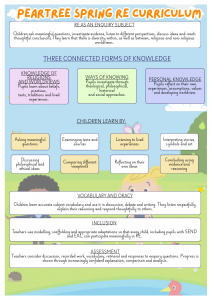 Right of withdrawal
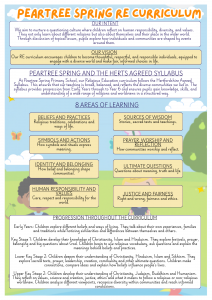
Parents and carers have the legal right to withdraw their child from all or part of Religious Education. We encourage anyone considering withdrawal to contact a member of the Senior Leadership Team or their child’s Year Group Leader so that the RE curriculum and appropriate arrangements can be discussed.

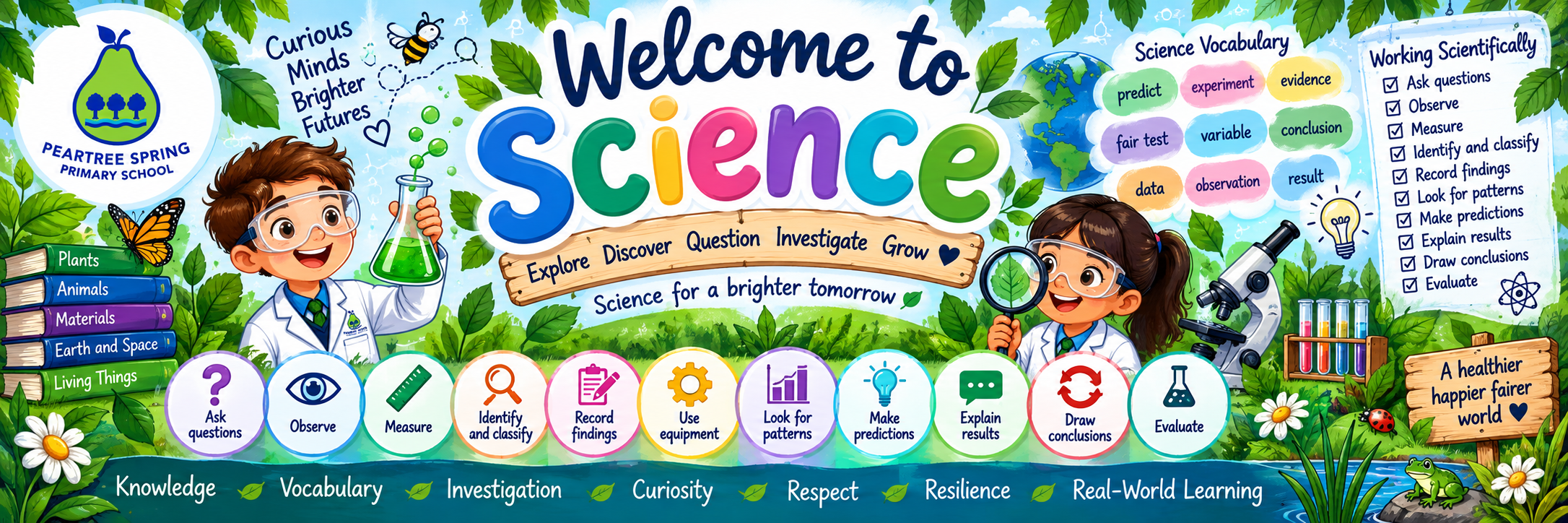
At Peartree Spring, we believe science begins with curiosity. Our aim is to inspire every child to question, explore and make sense of the world around them through exciting, purposeful investigations rooted in real-life experiences. We develop confident and independent scientific thinkers who can test ideas, gather evidence and draw their own conclusions, while ensuring that science is meaningful and accessible to every learner. By celebrating diverse scientists from the past and present, we want every child to recognise that science is for them and, ultimately, to inspire the scientists, innovators and problem-solvers of the future.
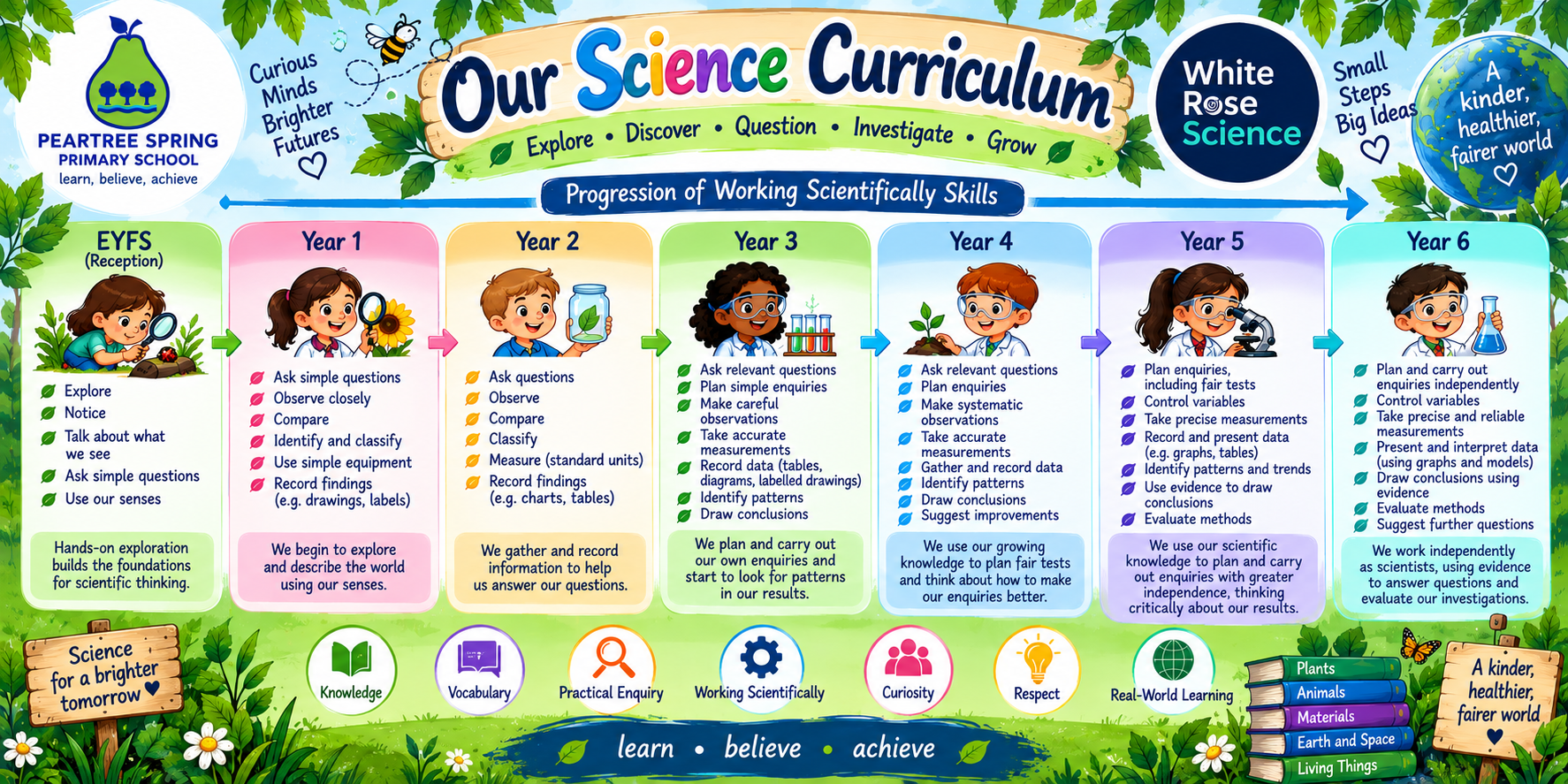 At Peartree Spring, our science curriculum is underpinned by the White Rose Science scheme of learning, providing a carefully sequenced journey from the early foundations of scientific thinking in EYFS through to increasingly independent scientific enquiry in Year 6. In Reception, children develop curiosity through practical, play-based exploration of the world around them; from Year 1 onwards, White Rose follows the National Curriculum and uses a small-step approach so that scientific knowledge, vocabulary and working scientifically skills are explicitly taught, revisited and progressively developed. As children progress through our school, they learn to ask increasingly purposeful questions, observe and measure accurately, plan enquiries, gather and present data, identify patterns, draw evidence-based conclusions and, in Key Stage 2, evaluate their methods. As teachers, we use our professional judgement to adapt learning to the needs of our children, providing meaningful practical experiences and real-life contexts while maintaining high expectations for all. In this way, knowledge and scientific enquiry develop together, enabling our pupils to leave Peartree Spring as curious, knowledgeable and increasingly independent scientific thinkers, well prepared for the next stage of their education.
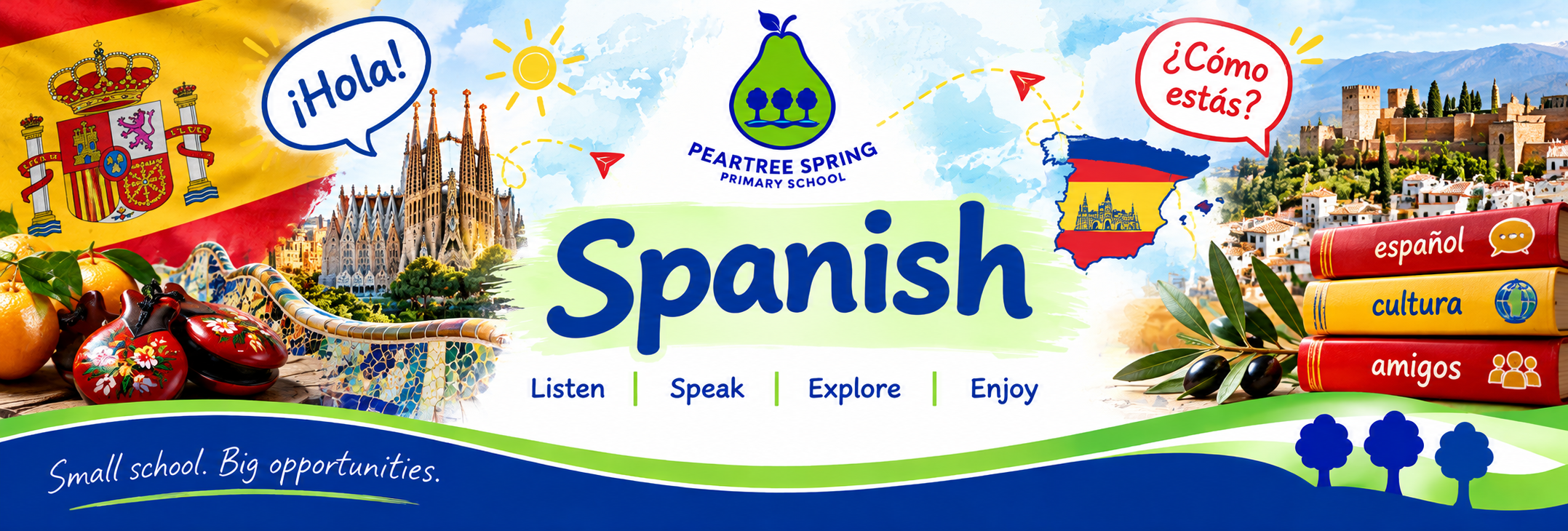
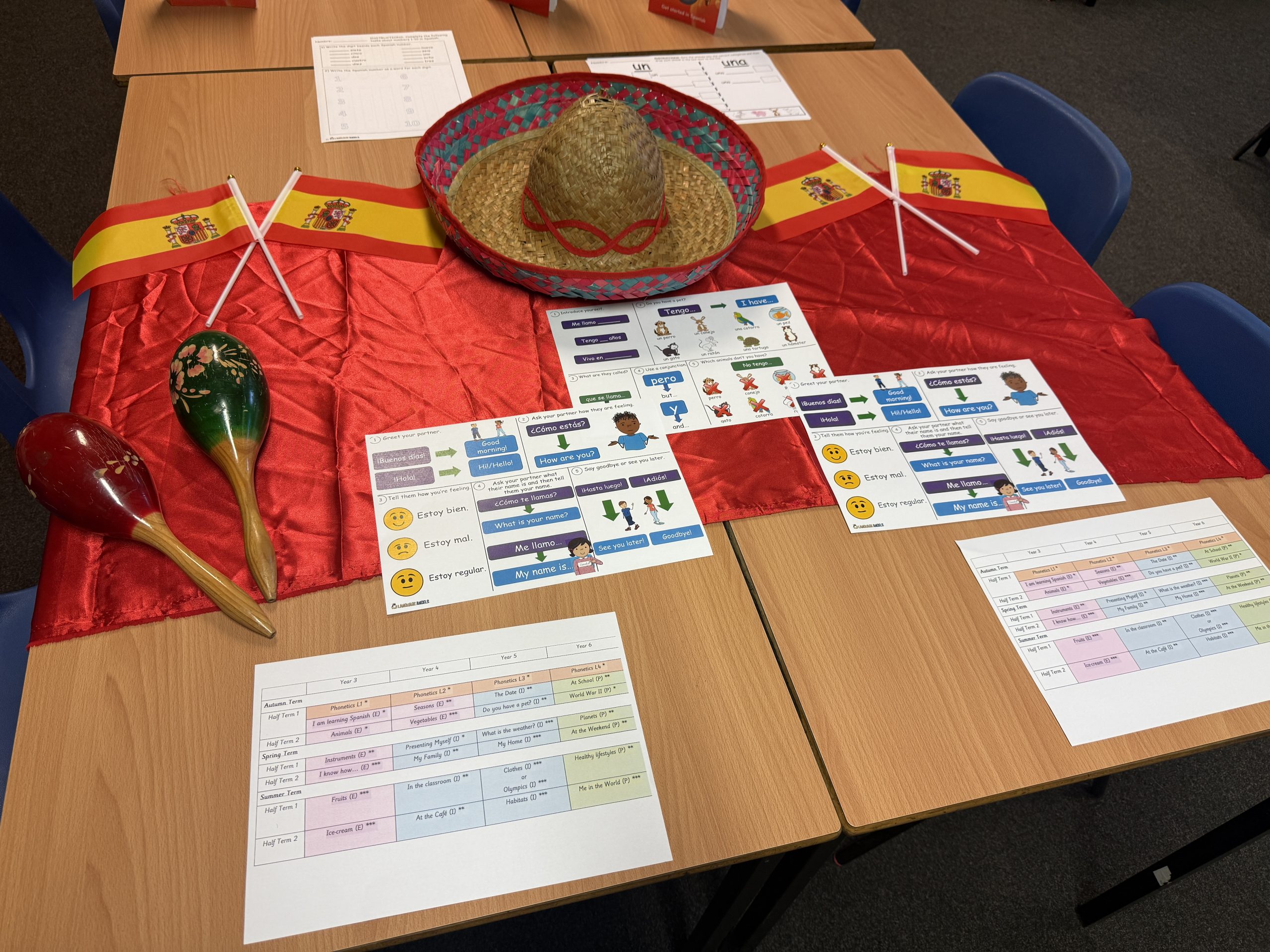


Hola!
We start learning Spanish in Key Stage 2 but in Key Stage 1 and EYFS we enjoy learning new words and phrases to use in their daily routines.
Here are some of the wonderful Spanish displays we have in every Key Stage 2 classroom.


We use Language Angels in the classroom to support our learning.


We aim to harness our children’s creativity, imagination and individuality through the power of writing. Our children are equipped with the knowledge, skills and vocabulary they need to communicate their ideas clearly, confidently and effectively for a range of purposes and audiences. Through engaging and purposeful writing opportunities, we aim to develop children who are enthusiastic and independent writers, who take pride in their work and understand the impact their words can have. We strive for our children to become skilled authors who can write creatively, critically and thoughtfully, whilst developing a secure understanding of spelling, grammar, punctuation and handwriting. We aim to inspire our children to see themselves as writers and to recognise that writing is a powerful tool for learning, communicating, influencing and expressing themselves throughout their lives.
At Peartree Spring Primary School, we want every child to become a confident, creative and purposeful writer. We believe that writing is a powerful way for children to communicate their ideas, express their creativity and make sense of the world around them.
Our writing curriculum is supported by Pathways to Write, which provides a carefully structured approach to developing children’s writing knowledge and skills through high quality texts. We use the scheme as a foundation for our teaching, adapting and enhancing it to meet the needs of our children and the context of our school.
Through a carefully sequenced curriculum, children develop the vocabulary, grammar, punctuation, sentence construction and composition skills they need to write effectively for a range of purposes and audiences.
We want our children to take pride in their writing, develop the confidence to experiment with language and become increasingly independent in planning, composing, editing and improving their work.
We use Pathways to Write as the foundation of our writing curriculum. It provides a progressive sequence of high quality texts and writing opportunities through which children develop their vocabulary, composition, grammar and punctuation knowledge. Our teachers use their professional knowledge to adapt and enhance the materials to ensure that learning is relevant, ambitious and responsive to the needs of our children.
At Peartree Spring Primary School, we use Pathways to Write as the foundation for our writing curriculum. The scheme provides a clear and progressive structure through carefully selected quality texts, enabling children to develop their writing skills while being immersed in rich vocabulary and engaging contexts.
Writing units follow a clear learning journey. Children are immersed in a text and its vocabulary before exploring the features of different types of writing. Teachers explicitly model writing and provide opportunities for children to discuss, practise and apply new knowledge.
Children develop their ideas through talk and oral rehearsal before applying their learning independently. They are taught to plan, compose, revise and edit their writing, with expectations for independence increasing as they move through the school.
Pathways to Write provides the structure for our teaching, while teachers use their professional knowledge to adapt lessons, provide appropriate support and challenge, and respond to the needs of their pupils.
Writing is closely connected to reading. High quality texts provide children with models of effective writing, introduce ambitious vocabulary and expose them to a wide range of authors, genres, structures and writing styles.
Our writing curriculum is carefully sequenced from EYFS to Year 6, ensuring that children continually build on previously taught knowledge and skills.
Pathways to Write provides a progressive framework for our writing units, with children working with quality texts and developing their understanding of vocabulary, composition, grammar, punctuation and text structure.
As children progress through the school, expectations increase in terms of the sophistication, accuracy and independence of their writing. Skills are revisited and developed in different contexts so that children have opportunities to secure their understanding and apply their learning independently.
Our progression documents show how writing knowledge and skills develop across the primary phase and how learning in each year group prepares children for the next stage of their writing journey.
Throughout their time at Peartree Spring Primary School, children experience a broad range of writing opportunities through our Pathways to Write units and additional writing opportunities across the curriculum.
Children write for different purposes and audiences, developing their ability to adapt their vocabulary, language, structure and style according to the task.
Our units include opportunities to write fiction, non fiction and poetry, alongside purposeful writing linked to the wider curriculum. High quality texts provide a starting point for children to explore different authors, genres, writing styles and vocabulary.
As children progress through the school, they are expected to make increasingly independent and sophisticated choices as writers, applying the knowledge and skills they have developed across different contexts.
Our end of year writing expectations provide a clear picture of the knowledge and skills we want children to have developed by the end of each year group.
These expectations complement the progression provided through Pathways to Write and outline the key knowledge and skills children need to develop in composition, vocabulary, sentence structure, grammar, punctuation and the organisation of their writing.
Expectations become progressively more challenging as children move through the school, supporting them to become increasingly accurate, effective and independent writers.
Teachers use these expectations alongside ongoing assessment to identify gaps, plan appropriate teaching and ensure that children are supported and challenged appropriately.
Assessment is an integral part of our writing curriculum. Teachers continually assess children’s understanding during lessons and through their independent writing.
Assessment takes place alongside our Pathways to Write curriculum, allowing teachers to identify what children know, what they can apply independently and where further teaching or practice is required.
Teachers use assessment information to address misconceptions, revisit key knowledge and plan future learning. Children’s writing is assessed against the knowledge and skills that have been taught, with increasing expectations for independence and application as children progress through the school.
Teachers work collaboratively to moderate writing and develop a shared understanding of expectations. This helps to ensure consistency across the school and enables us to accurately identify children’s strengths and areas for development.
We believe that every child can become a successful writer. Our use of Pathways to Write provides a consistent and structured approach while allowing teachers to adapt teaching to meet the individual needs of their pupils.
Children who require additional support may benefit from vocabulary pre teaching, oral rehearsal, modelled and shared writing, sentence scaffolds, targeted adult support and additional opportunities to practise key skills.
Teachers use assessment to identify gaps in learning and respond through classroom teaching, targeted support and intervention where appropriate.
Children who demonstrate a strong understanding are given opportunities to deepen their knowledge, develop greater independence and make increasingly sophisticated choices as writers.
Our aim is for every child to develop the knowledge, confidence and independence to communicate their ideas effectively through writing.
Writing develops through regular opportunities to talk, read, write and share ideas. Parents and carers can support their child’s development by encouraging them to talk about their experiences, discuss new vocabulary and take an interest in the writing they produce at school.
Our Pathways to Write units expose children to a wide range of quality texts and vocabulary. Parents can support this learning by discussing the books and topics children encounter in school and encouraging them to use new vocabulary in conversation.
Children can also be encouraged to write for real purposes at home, such as shopping lists, letters, stories, postcards, instructions, reviews or diary entries.
Most importantly, we want children to see writing as meaningful, enjoyable and useful, and to develop the confidence to share their ideas through writing.


At Peartree Spring Primary School, we recognise that fluent, legible handwriting is an important part of becoming a confident and successful writer. We use Penpals as our handwriting scheme, providing a consistent and progressive approach to developing handwriting skills across the school.
Children are explicitly taught correct letter formation, joining, spacing, size and positioning. Handwriting skills are practised regularly and progressively developed so that children become increasingly fluent and automatic in their writing.
Our handwriting teaching supports children to develop a comfortable and efficient writing style which enables them to record their ideas with increasing speed, accuracy and confidence. Children are encouraged to take pride in the presentation of their work and to understand that handwriting should be adapted appropriately for different purposes.
Handwriting is closely linked to our wider English curriculum, with children given regular opportunities to apply their handwriting skills when completing independent writing and work across the wider curriculum.
Our handwriting curriculum follows a clear progression from EYFS to Year 6. Children move from developing the fine motor control and correct formation needed for early writing towards increasingly fluent, joined and automatic handwriting.
As children progress through the school, they develop:
Our progression ensures that new skills build upon previously taught knowledge and that children have regular opportunities to practise, apply and refine their handwriting.
We have high expectations for the presentation and legibility of children’s handwriting. Children are taught to form letters accurately and develop a consistent style as they progress through the school.
We expect children to apply their handwriting skills across all areas of their learning, not just during dedicated handwriting sessions. As children become more fluent, they are expected to maintain the quality of their handwriting when writing at greater length and at increased speed.
Children are encouraged to recognise that handwriting is a tool for communication and that clear, fluent handwriting allows their ideas to be understood easily by others.
We recognise that handwriting develops at different rates and that some children require additional support to develop the physical and transcription skills needed for fluent writing.
Teachers provide additional modelling, practice and targeted support where required. Children may receive support with pencil grip, posture, letter formation, spacing, joins or writing stamina.
Where appropriate, children are provided with adapted resources and additional opportunities to practise specific skills. The aim is always to develop increasing independence and fluency rather than reliance on adult support.
Handwriting is not just taught as an isolated skill. Children are expected to apply their developing handwriting knowledge and skills throughout their learning.
As handwriting becomes increasingly fluent and automatic, children are expected to maintain consistent presentation when completing English work and work across the wider curriculum.
This ensures that children understand the purpose of handwriting and develop the stamina and fluency needed to record their learning effectively.

Peartree Spring Primary School
Hydean Way
Stevenage
Herts
SG2 9GG
© 2021 Peartree Spring Primary School